


At Cavell Enable in London this week, one session stood out—not because of a product announcement, but because it captured a strategic shift happening across the collaboration and communications ecosystem.
Marcel Kardol, Director SP Sales EMEA at Cisco, articulated something that many in the industry have felt emerging for months:
The future of collaboration will not be defined by cloud-only thinking. It will be defined by sovereignty, security, and the service provider’s role at the center of national digital infrastructure.
It was subtle, understated, but unmistakably clear.
Cisco is repositioning for a world where AI and geopolitics are reshaping how communications platforms must be built, governed, and deployed.
1. AI, Geopolitics and the Return of Sovereignty
The industry often frames this shift as an “AI story.”
But the return of sovereignty predates AI—and is being intensified by it.
Around the world we now see:
- Governments demanding in-country data storage
- Regulators tightening rules for digital resilience
- Critical industries requiring verified local control
- Foreign cloud dependency becoming a national-level risk
- Enterprises reevaluating where their communications stack truly “lives”
Then AI arrives—adding new questions:
- Where is inference executed?
- Who governs the model?
- How is training data handled?
- What is explainable, auditable, or export-controlled?
AI is the spark, but geopolitics is the accelerant.
Together they push the market firmly toward hybrid architectures, sovereign infrastructure, and SP-governed platforms.
Cisco understands this.
And their strategy now reflects it explicitly.
2. Cisco’s Architecture: Built for Trust, Control and AI at the Edge
Marcel anchored Cisco’s strategy in four pillars:
- AI-ready data centres (strengthened through NVIDIA and sovereign-cloud partnerships)
- Future-proof workplaces, where AI runs at the edge, in the device, and in the cloud
- Secure global connectivity
- Digital resilience, built into the entire stack
All accelerated by Cisco AI and extending earlier 2024–2025 Cisco/Webex announcements around:
- Agentic AI teammates
- Distance Zero experiences
- Zero-Trust collaboration models
- Secure, sovereign AI inference
- Responsible AI frameworks
This is no longer “AI as a feature.”
This is AI as an architectural principle—a principle that requires sovereignty, locality, and trust.
3. The Installed Base Is Strategic, Not Legacy
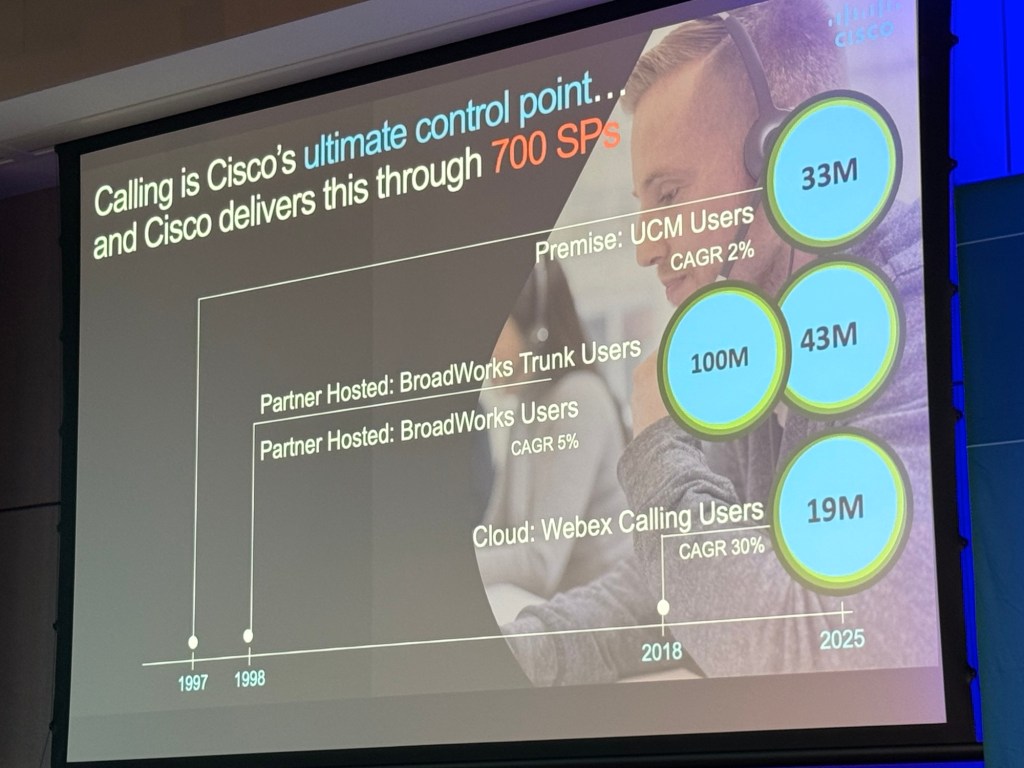
The slide that landed hardest was the one with the numbers:
- 33M UCM seats (CAGR 2%) — powering governments, law enforcement, and heavily regulated industries
- 100M SIP trunks still connected to on-prem PBXs
- 43M BroadWorks hosted seats (CAGR 5%) — a surprisingly strong growth story
- 19M Webex Calling users (CAGR 30%)
- 700 service providers globally, including 200 in Europe
These aren’t relics of the past.
They are the sovereign substrate for the AI era.
The key insight:
Hybrid didn’t survive despite the cloud revolution—
hybrid is thriving because of the AI + geopolitics revolution.
4. Cisco Kills Three Myths—and Reveals the Real Strategy
Marcel addressed three misconceptions head-on:
Myth 1: “Cisco is moving away from on-prem.”
Reality: The opposite.
In September Cisco launched its Sovereign Critical Infrastructure Portfolio, targeting exactly the markets where local control is non-negotiable.
Myth 2: “Partner-hosted (BroadWorks) is fading.”
Reality: BroadWorks continues to grow, driven by renewed demand for sovereignty.
Cisco is even releasing new AI capabilities—like Customer Assist—specifically for the SP-hosted BroadWorks base.
Myth 3: “Everyone must move to the Webex cloud.”
Reality: Webex Wholesale has become a quiet success story.
It keeps the SP in control of the relationship, deployment, and commercial model—precisely what SPs want.
The message behind these myth-busters:
Cisco is not collapsing architectures into the cloud.
Cisco is expanding architectures to meet sovereign and geopolitical realities.
5. The Underrated Strength: Multi-Platform Devices
Cisco’s device story is more strategic than it appears.
Their headsets, phones, cameras and room systems support:
- Webex
- Zoom
- Microsoft Teams
- SP-hosted calling environments
This matters because enterprises now operate in multi-vendor, multi-platform reality.
SPs need hardware consistency, investment protection, and AI-ready endpoints regardless of which UCaaS vendor is in fashion at a given moment.
This device flexibility aligns perfectly with Cisco’s Agentic AI roadmap, where intelligence increasingly lives at the edge, not only in the cloud.
6. Responsible AI: Where Cisco Gets It Right
Marcel spent time reiterating Cisco’s Responsible AI Principles—transparency, accountability, fairness, privacy, reliability, and security.
This is not cosmetic.
It is what allows Cisco—and SPs—to play credibly in:
- national infrastructure
- emergency services
- healthcare
- financial institutions
- government agencies
You cannot deploy AI into these sectors without governance-first architecture.
Cisco is one of the few vendors in collaboration that treats this as a core engineering requirement, not a marketing slide.
7. What This All Means for Service Providers
Combining everything Marcel shared, the picture becomes clear:
- Hybrid isn’t transitional — it’s foundational.
- SP-hosted models aren’t legacy — they’re resurging.
- The cloud isn’t the destination — it’s one of several sovereign deployment options.
- AI doesn’t weaken the SP — it makes the SP strategically necessary.
- Geopolitics isn’t external noise — it’s shaping architecture.
Or, more directly:
The Service Provider is returning to the center of the collaboration and AI value chain.
Not as a reseller of cloud seats, but as the trusted operator of sovereign, AI-ready digital infrastructure.
Cisco’s strategy now reflects that world.
And based on Marcel’s session, they are designing their next decade around it.
Final Thought
Cavell Enable didn’t reveal a Cisco “comeback.”
It revealed a Cisco realignment — toward sovereignty, toward SPs, and toward the geopolitical and AI realities that now define enterprise communications.
For those of us working at the intersection of CPaaS, Intelligent Engagement, and network transformation, this moment feels familiar:
The industry is shifting from generic platforms to strategic, sovereign, AI-powered architectures.
And Cisco is positioning itself to be the backbone SPs build on.