


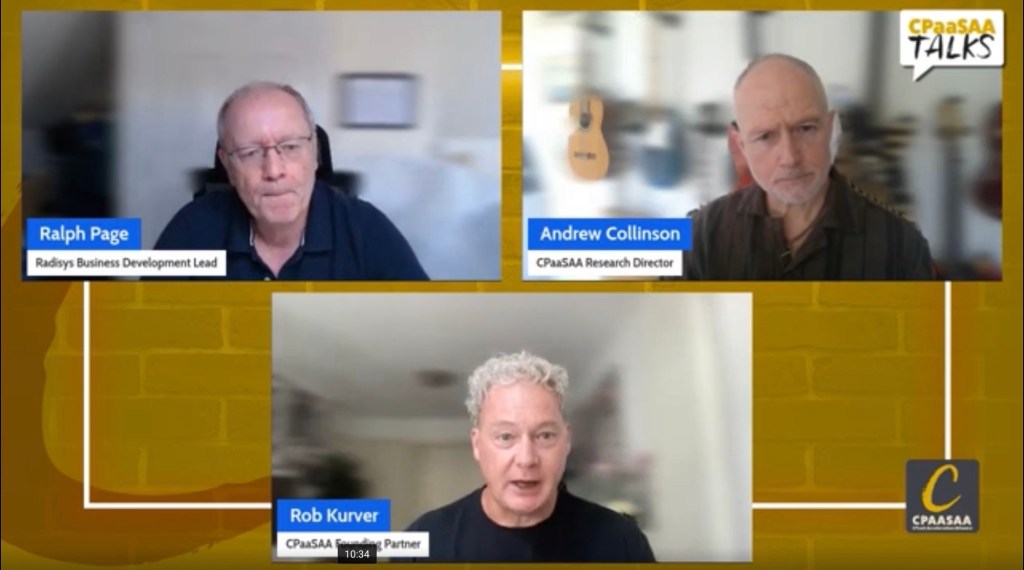
AI voice is moving into the core of the network. In the latest CPaaSAA Talk, Ralph Page of Radisys and CPaaSAA’s Andrew Collinson set out what that changes — and why the real contest is over who runs the conversation.
Something shifted at MWC Barcelona this year. A handful of large operators — T-Mobile, Deutsche Telekom and Rakuten among them — stood up and announced that transcription, translation and live AI were now running inside the core of the network, on ordinary calls. Deutsche Telekom’s Magenta AI Call Assistant put real-time translation and admin support into everyday phone calls, on any device, with nothing to install. Rakuten, with Nokia, took its cloud-native IMS voice core live in commercial operation — the kind of programmable foundation that makes putting AI inside a call possible in the first place. “We couldn’t have done this three months ago,” DT’s Chief Product and Digital Officer Jon Abrahamson told us at the show.
The telling part isn’t that they couldn’t have. It’s that they did.
That woke the industry up — and it set the agenda for the latest CPaaSAA Talk, where CPaaSAA Founding Partner Rob Kurver sat down with Ralph Page, who is responsible for Radisys’ AI-enabled solutions business development, and Andrew Collinson, CPaaSAA’s head of research and the author of AI Voice: Who Will Run the Conversation?, published in March. Ralph has spent four years working on how to get AI into the network. His verdict on the last three months was blunt: he hasn’t been this busy in twenty-five years of doing cloud. Everybody suddenly wants to know what’s possible — and everybody is finding out at the same time.
Voice just became data
For decades, the value in a call sat in the call itself. A great contact centre with skill-based routing was the killer capability a few years ago, then workflow management on top of it. Kurver brought back an observation from a recent CX summit in London: everyone now agrees value has moved up the stack — from the communication itself to the conversation, and then to the intelligence inside it. That’s why CRM players are buying and building contact centres, and why CCaaS and CRM are starting to look like the same fight. If conversation is intelligence, you want to own the raw voice.
Andrew put the underlying shift more plainly. We have suddenly turned voice into data. All those calls that used to vanish into the ether — or, if you were lucky, left two lines in a CRM — are now captured, transcribed and computable. That is not a feature. It is a change in what the asset is.
He sees three opportunities, all with serious legs, and it is genuinely not clear yet which one dominates. The first is enterprise efficiency — AI voice automating bookings, handling the interactions people don’t want, sitting in place of a person or alongside one. The second is the telco play: AI on any call — translation, summarisation, fraud detection, assistance — the moment you pick up the phone. The third is voice-as-data itself: the back catalogue of every conversation, finally available to do something with. The market is so early that all three are running flat out at once.
No app. That’s the whole point.
Here is what makes the network play structurally different. Radisys sits inside the IMS — the core where calls are anchored — and there are only one or two companies in the world that can do that. Once you are in there, the user needs nothing. No download. No specific handset. No app to install first.
That sounds like a technical detail. It is a commercial one.
When an elderly person calls their doctor, they are not going to install an app — they don’t know how, and they shouldn’t have to. When you want to book a table at a restaurant in China that has a phone number and no website, you should be able to ring it from your normal dialler and have the call translated on the fly. These are telecoms-shaped problems. We have always understood that people who speak different languages can’t talk, and that fraud is a problem. The network is the natural home for solving them.
The more interesting move is what comes next. Verticalisation — and then, as Kurver put it to Ralph, hyper-verticalisation, the world that CPaaS triggered and that AI is now amplifying massively. Ralph’s example stuck with us: AI is reaching the point where it can listen to a voice and flag whether someone might have pneumonia rather than a chest infection. That is not a telecoms problem. We don’t understand it. But the network is where the call happens, and the building blocks now exist to bring a specialist model into a native call and let it do the clever part.
Which opens the door that should make this industry sit up. There are hundreds of AI voice specialists out there, a lot of them in and around Silicon Valley, raising serious money and building specific solutions. If some of that gets built on top of native telco capability, rather than around it — that would be massive. The network stops being a pipe and starts being a platform that startups, scale-ups and sovereign AI players plug into.
So who runs the conversation?
This is the question the report was built around, and Andrew is right not to pretend it’s settled. The critical decision is who owns the runtime — who controls which bits do what. Call it governance, call it orchestration; it is the layer where the value accrues. Everyone wants to be the spider in the centre of the web, and right now nobody knows who that will be.
His honest answer is that it won’t be one winner. It will be several ecosystems, competing and overlapping, conditioned by regulation and by what each market will allow. You’ll be able to do things in one country that you can’t do in another. That sounds messy. It’s also probably healthy — for the market and for customers.
And it is exactly why the orchestration layer, not the model, is where this gets decided.
Compliance stops being the brake
It’s a point Kurver kept coming back to. The thing this industry has treated as the handbrake — regulation, compliance, sovereignty — is becoming the accelerator.
Without guardrails in an AI era, all hell breaks loose. But guardrails are also what large enterprises need before they’ll move at all. Think about healthcare: nobody touches it without clarity on what’s allowed. The US instinct is to let it happen and see you in court; the European instinct is to wait for the regulator before doing anything. And when Andrew talked to a UK regulator recently, the most revealing line was that operators are often too fearful — imagining restrictions that aren’t there. A good share of the regulatory impotence we complain about lives inside the operator’s own head, not in the rulebook.
That fear is a commercial opening for whoever clears it. Ralph made the point well: as we move to AI assistants that are genuinely useful, they need access to private information — your schedule, your pricing, your context. You are not going to put that out on the open internet and hope for the best. But an assistant you buy from your mobile operator, that works inside your call, meets the regulations and keeps your data in a GDPR-grade, sovereign environment — that you can trust. Ralph’s own signal of how fast this is moving: in January he fielded a couple of questions a month about where the LLM physically sits. Now it’s every single day.
Trust, proximity, regulatory standing, national infrastructure — these are the assets telcos spent years apologising for being slow about. They are now the differentiator. Regulation and compliance are shifting from a nuisance into an accelerator, and the operators who work with regulators to build the frameworks — rather than waiting to be told — will set the pace.
What to watch
By MWC next year, expect the telecom-native applications — live translation, AI assistance, fraud, transcription, notes and summaries — to read as mainstream rather than novel. Expect to be surprised by solutions built for medical, concierge or retail that turn out to work beautifully inside a call. And expect the real bottleneck to be adoption, not capability: most people still don’t know what to do with any of this. Ralph’s line landed — tell a brilliant lawyer to “just put your transcriptions into ChatGPT” and they’ll look at you and say, in what? The next phase of value is teaching people to use what already works.
That is the thread we’ll pull at CASA26 in Amsterdam this September, where Andrew kicks off the second round of CPaaSAA’s AI voice research and Radisys joins us as a sponsor. The technology question is largely answered. The interesting questions now are commercial: what gets solved, for whom, at what price — and who ends up running the conversation.
Connectivity still matters. But the value of communications has moved from carrying the call to orchestrating the intelligence inside it.
The call is the platform now. The contest is over who controls it.
This is a recap of a CPaaSAA Talk moderated by CPaaSAA Founding Partner Rob Kurver, with Ralph Page (Radisys) and Andrew Collinson (CPaaSAA). Watch the video here: https://youtu.be/_As3HvdSKLQ
The full research, “AI Voice: Who Will Run the Conversation?”, is available here.