


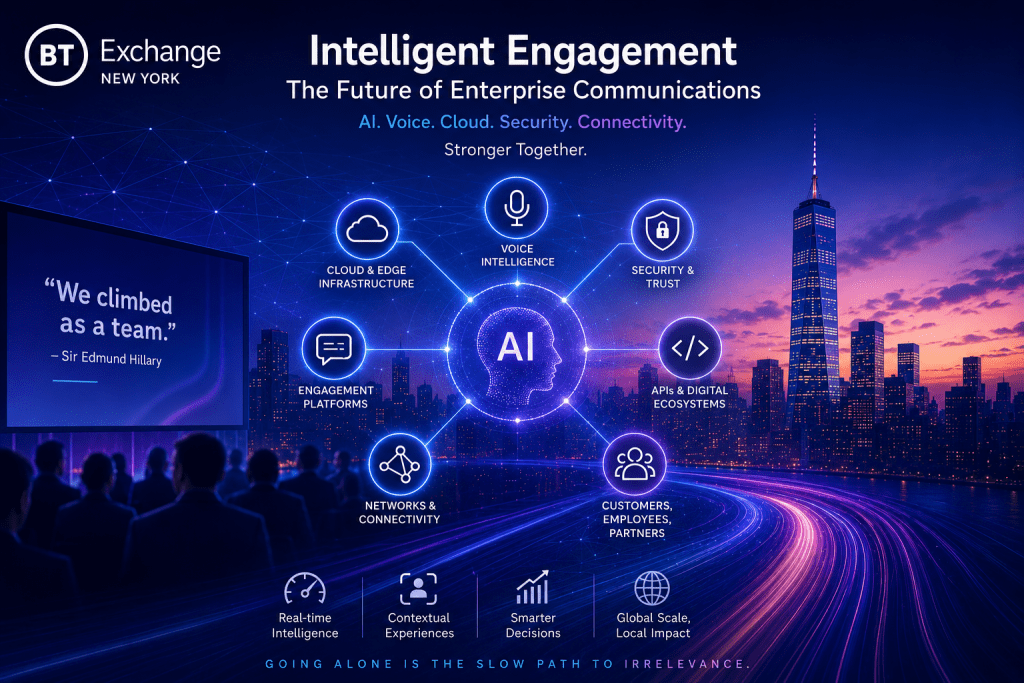
Last week’s BT Exchange event in New York felt like more than a customer or partner gathering. It felt like a signal.
Not necessarily because every presentation was perfect — in fact, I would argue there is still enormous untapped potential in how our industry tells its story — but because the themes emerging across the discussions increasingly point toward a much larger market transition.
The worlds of enterprise communications, AI, cloud infrastructure, cybersecurity, networking, customer engagement, and digital transformation are rapidly converging.
And increasingly, they are converging into what we at CPaaSAA call Intelligent Engagement.
The Industry Is Moving Beyond Channels
One of the strongest themes throughout the event was that communications are no longer being viewed as isolated channels.
Voice is no longer just voice.
Messaging is no longer just messaging.
Networks are no longer just connectivity pipes.
The keynotes from BT, Cisco, Equinix, and Five9 consistently pointed toward a future where communications become embedded intelligence layers across enterprise workflows.
A few slides particularly stood out:
- “Voice and UC are becoming decision surfaces, not just channels.”
- “The edge is where AI insight meets human expectation.”
- “Success is measured by confidence and clarity, not automation rates.”
- “The pace of change has outrun any single company’s ability to keep up.”
- “Going alone is the slow path to irrelevance.”
Those statements matter because they reflect a broader industry reality.
The enterprise market is entering an era where AI is becoming operational infrastructure rather than an isolated toolset. Enterprises are no longer simply deploying AI chatbots or testing copilots. They are trying to redesign workflows, customer journeys, security architectures, compliance models, and engagement strategies around real-time intelligence.
That is exactly where communications platforms, CPaaS, CCaaS, APIs, cloud infrastructure, and AI begin to merge into one strategic conversation.
Intelligent Engagement Is Becoming Real
This aligns closely with the Intelligent Engagement framework CPaaSAA has been developing across our research and industry activities.
The core idea is relatively simple:
Enterprises are moving away from fragmented communication tools toward integrated, AI-enabled engagement systems that operate in near real-time across customers, employees, partners, and connected systems.
That shift changes everything.
It means:
- AI becomes part of communications
- Communications become part of workflows
- Networks become part of application logic
- Security becomes embedded into engagement
- Voice becomes a source of intelligence
- APIs become strategic business enablers
What struck me at BT Exchange was that many ecosystem players are independently arriving at similar conclusions.
The Importance of Ecosystems
One of the clearest messages throughout the event was that no single company can solve this transition alone.
The combination of BT, Cisco, Equinix, Five9, and others on stage reinforced this reality.
Jonathan Rosenberg, CTO and Head of AI at Five9, brought a particularly valuable perspective around how AI and enterprise communications are converging.
Equinix discussions around infrastructure, Global Fabric, multi-cloud architectures, and digital ecosystems highlighted another critical point: AI is creating entirely new infrastructure demands.
Meanwhile Cisco’s framing around security, hybrid work, networking, and AI-driven enterprise transformation reinforced how enterprise architectures are becoming deeply interconnected.
This ecosystem logic is increasingly unavoidable.
AI workloads require cloud and edge infrastructure.
Cloud requires networking.
Networking requires security.
Customer engagement requires AI.
AI requires trusted data and communications.
Communications require orchestration across platforms.
The industry is no longer selling isolated products.
It is assembling interconnected operational ecosystems.
Why Voice Matters Again
One particularly important discussion area was voice and UC Edge.
For years, voice often felt like the “legacy” layer of enterprise communications while messaging, apps, and digital channels captured most of the innovation energy.
That is changing fast.
AI is revaluing voice.
Voice is becoming:
- searchable
- transcribable
- analyzable
- automatable
- contextual
- compliant
- intelligent
This directly connects to CPaaSAA’s recent AI Voice discussions and broader work around conversational intelligence and vCons.
The implications are enormous.
Voice is evolving from a communication medium into an intelligence layer.
And once conversations become structured data, entirely new opportunities emerge:
- compliance
- customer intelligence
- workflow automation
- AI copilots
- fraud prevention
- enterprise memory
- decision support
- personalization
The industry is still only beginning to understand the scale of this transition.
The Real Opportunity: Innovation Acceleration
What I perhaps found most interesting about the event was not any individual technology discussion, but the growing realization that enterprises are struggling to keep up with the pace of change itself.
One Cisco slide captured this perfectly:
“The pace of change has outrun any single company’s ability to keep up.”
That is precisely why ecosystems, alliances, and innovation acceleration platforms are becoming increasingly important.
At CPaaSAA, this is one of the core reasons we are evolving beyond a traditional alliance model toward what we increasingly describe as an ecosystem acceleration platform.
Our role is not simply to organize events or discussions.
It is to help:
- connect ecosystems
- accelerate understanding
- identify emerging patterns
- showcase real-world use cases
- bridge industries
- reduce fragmentation
- create strategic alignment
- accelerate innovation pathways
This is also why we are increasingly connecting:
- CPaaS
- AI
- enterprise communications
- telcos
- network APIs
- identity
- trust
- cloud infrastructure
- investors
- enterprise IT
- scaleups
The convergence is real.
And the companies that understand how to orchestrate ecosystems rather than simply sell products will likely have a major advantage over the next five years.
Why Startups Matter More Than Ever
Another important realization emerging from these discussions is that large enterprises and established technology players will not innovate fast enough alone.
Many of the most important breakthroughs around conversational AI, intelligent engagement, trust, voice intelligence, sovereign AI, agentic workflows, and API-enabled automation are increasingly coming from startups and scaleups operating at the edge of the ecosystem.
That is one of the reasons why CPaaSAA is working more closely with Sandbox Industries and others around innovation acceleration and future investment initiatives.
The opportunity is not simply to discuss the future.
It is to help identify, support, connect, and potentially invest in the next generation of companies shaping that future.
Because if Intelligent Engagement becomes one of the defining enterprise technology shifts of the next decade, then the ecosystem needs:
- enterprise buyers
- operators
- hyperscalers
- infrastructure players
- AI leaders
- developers
- and startups
all innovating together.
The future winners may not just be the companies with the biggest infrastructure or largest customer bases.
They may be the ecosystems that accelerate learning, experimentation, co-creation, and adoption the fastest.
The Industry Still Needs a Better Narrative
At the same time, I honestly think the industry still struggles to tell this bigger story clearly enough.
Many presentations across telecoms and enterprise communications still focus heavily on:
- products
- technical features
- infrastructure layers
- isolated use cases
- disconnected capabilities
But enterprises increasingly need strategic guidance.
They need help understanding:
- what AI changes operationally
- how engagement models evolve
- where trust and security fit
- how ecosystems connect
- how communications become intelligence
- how to navigate complexity
The real opportunity is not simply selling APIs, cloud, or AI tools.
The opportunity is helping enterprises navigate the AI era itself.
That requires a much bigger narrative.
Final Thoughts
BT Exchange NYC showed strong signs that the market is moving in the right direction.
Not because every answer already exists.
Not because every presentation fully captured the opportunity.
But because the right conversations are increasingly happening across the ecosystem.
The strongest takeaway for me came from the Sir Edmund Hillary quote shown during the event:
“We climbed as a team.”
That may ultimately become the defining principle of the AI and Intelligent Engagement era.
No company will build this future alone.
Thanks again to Joris van Oers, Lynne De Forest, Colm Sunderland, Eyad Shihabi, Jonathan Rosenberg, the BT International team, and all ecosystem partners involved for creating a genuinely thoughtful industry conversation.
The next step now is turning these conversations into real acceleration.