


Executive summary (for the impatient)
The Unthinkable Lab event in London, organized by TelecomTV with Andrew Collinson and Dean Bubley, made one thing unmistakably clear:
Network APIs will not unlock value on their own — but combined with agentic AI, they could finally become meaningful.
Across a tightly curated morning of expert presentations and a highly practical afternoon of group work, there was strong alignment on three points:
Agentic AI is not incremental — it is a structural shift that will change how work, value creation, and decision-making happen across the economy. APIs are necessary but insufficient. The missing layer is products: real, end-to-end solutions built with customers, not documentation for developers. No single telco, vendor, or enterprise can close this gap alone. Progress requires cross-company collaboration, shared experimentation, and new investment models.
For CPaaS Acceleration Alliance, the discussions strongly validated three initiatives already underway:
– the Case Directory of real-world use cases,
– a focused telco–enterprise workshop format around Network APIs,
– and a venture / investment vehicle (with Sandbox) to scale what actually works.
What follows is a deeper walk through how the day unfolded — and why it matters.
Setting the stage: why this matters now
In my opening remarks, I framed the day around a simple belief:
the world deserves more intelligent engagement.
Not more dashboards, not more APIs for their own sake — but use cases that genuinely matter to people and businesses. From customer trust and fraud prevention to automation, compliance, and safety, these are problems where telcos should have an advantage.
Two themes were central from the outset:
First, sovereignty. As AI becomes more autonomous and embedded, questions around data, control, jurisdiction, and trust move from “nice to have” to existential. This is where telcos have a real opportunity — if they move beyond connectivity and expose capabilities in usable ways.
Second, what happens when APIs are put directly in the hands of agentic AI. Not humans clicking buttons, but software agents reasoning, planning, and acting across systems. If that happens at scale, things will indeed “go completely mad” — in both promising and unsettling ways.
That set the tone perfectly for the morning.

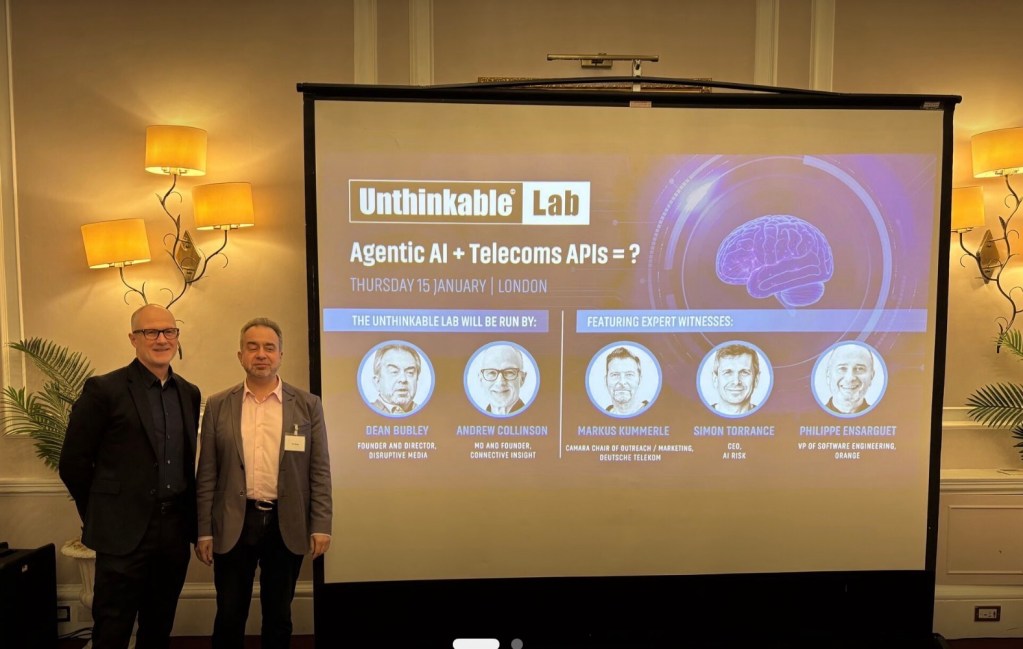
Simon Torrance: agentic AI is not a feature — it’s a revolution
Simon Torrance delivered what was arguably the most macro-level intervention of the day, and it landed hard.
He started with a sobering statistic: around 45% of the Western workforce are knowledge workers. These are people paid primarily to think, analyze, decide, coordinate, and communicate. Agentic AI directly targets that layer of the economy.
This is not about chatbots answering questions faster. Simon made it clear: agentic AI systems can already perform complex, multi-step work autonomously — planning tasks, invoking tools, coordinating with other agents, and adapting based on outcomes.
He shared examples of agentic platforms capable of doing in hours what would traditionally take teams of consultants weeks. Not because they are “smarter” in a human sense, but because they can explore vast solution spaces, run parallel experiments, and iterate relentlessly.
For telcos, this creates both a threat and an opportunity.
The threat is obvious: if intelligence, orchestration, and value creation move elsewhere, telcos remain infrastructure providers with shrinking margins.
The opportunity is more subtle but powerful: agentic AI needs reliable, trusted, real-world capabilities — identity, location, authentication, quality of service, messaging, payments, and more. Exactly the things telcos already have, but rarely productize well.
Simon’s conclusion was blunt:
this shift will happen. Most people in the room believed it will happen. And most, cautiously, said they even like the direction of travel.
The open question is who captures the value.
Markus Kümmerle: APIs don’t fail — products do
Markus brought the discussion back down to earth, squarely into telco reality.
His core message: selling APIs doesn’t work. Not because APIs are wrong, but because APIs alone are not products. Telcos have spent years exposing technical capabilities, yet adoption remains limited and fragmented.
A key insight was reframing AI not as a solution to the telco dilemma, but as a new type of user.
AI will not magically fix broken business models.
But agentic AI will dramatically increase API consumption — if the APIs are usable, composable, and embedded in workflows that actually solve problems.
This is where Model Context Protocol (MCP) entered the conversation. Markus described MCP as a natural extension channel — almost an SDK for AI agents — allowing them to discover, understand, and invoke services dynamically.
Importantly, MCP is now open source under the Linux Foundation’s Agentic AI Foundation (AAIF), signaling that this is becoming real infrastructure, not an experiment.
He didn’t gloss over the risks:
– prompt injection,
– malicious servers,
– security and observability gaps,
– regulatory complexity across domains,
– and traceability in autonomous systems.
He also noted a telling reality check: there are no formal MCP production projects yet at major operators like Deutsche Telekom or Vodafone, despite strong interest in the room.
The takeaway was clear: the technology is moving faster than organizational readiness. And again, the bottleneck is not standards — it’s productization.
Philippe Ensarguet: the most important slide deck of the morning
Philippe’s presentation resonated deeply because it came from lived telco experience.
He used a simple but powerful metaphor: an API is just a door. MCP is also just a door. What matters is what system you build behind it.
Agentic AI, he argued, is not a feature you bolt on. It is a system architecture that requires careful design, clear ownership, and real engineering discipline. This is not something you “hack together” and hope for the best.
Several points stood out:
– Determinism matters. In regulated, mission-critical environments, “it usually works” is not good enough.
– MCP is just a wrapper. Anyone can build one in a few lines of code — which makes governance and quality even more important.
– We are seeing a rapid evolution of agentic architectures, but very little clarity on which services should actually be exposed and monetized.
Perhaps the most striking moment was his acknowledgment of discomfort.
Paraphrasing: If you’re not at least a little bit scared of this, you’re not paying attention.
Capitalism will push us in this direction regardless. Enterprises will deploy agentic systems to remain competitive. The real question is whether telcos help shape this future — or are bypassed by it.
And crucially: the players who move early will build compounding advantages that are hard to claw back later.
The afternoon: from insight to action
The afternoon sessions shifted deliberately from theory to practice.
In smaller, mixed groups, participants worked through concrete use cases and stakeholder perspectives. What was striking was how quickly conversations converged — regardless of background — on the same conclusion.
At the channel partners table, where I spent much of the time, the gap became explicit:
The gap is not API definitions.
The gap is products.
Not slideware.
Not developer portals.
Not yet another standards initiative.
What’s missing is structured, repeatable work with real customers, building real solutions, learning what actually works, and then scaling those into meaningful businesses.
That process is:
– cross-functional (business, product, tech, legal),
– cross-company (telcos, vendors, enterprises, integrators),
– and inherently risky.
Which is exactly why it doesn’t happen often enough.
No single telco can carry that risk alone.
No single enterprise wants to be the guinea pig.
No single vendor has all the pieces.
Why this aligns so strongly with what we’re building at CPaaSAA
This is where the day came together beautifully for me.
Three outcomes discussed at the table map almost one-to-one to CPaaS Acceleration Alliance initiatives:
- The Case Directory – Not “inspiration”, but documented use cases showing what works, why it works, and under which conditions. This is how you move the conversation from possibility to credibility.
- Focused telco–enterprise workshops – Exactly what we’re now building in the Telco API Working Group: structured sessions aimed at identifying where the money actually is, not just what is technically possible.
- A venture / scaling mechanism – Described in the room as a “Y Combinator for Telco” — which is precisely what we are working toward with Sandbox: a way to take validated ideas and give them the capital, structure, and ecosystem needed to scale.
None of this is about replacing telcos or centralizing innovation. It’s about creating a shared path from experiment to product to business.
Final reflection
The Unthinkable Lab was genuinely one of the more useful industry events I’ve attended recently. Credit is due to the organizers and to TelecomTV for creating a space that balanced deep expertise with honest discussion and practical outcomes.
As an alliance partner, we’ll absolutely continue to support and encourage our members to attend future editions.
More importantly, the day reinforced something I strongly believe:
Network APIs and agentic AI only become meaningful when they are pulled into real-world problem solving.
The alignment around next steps — use cases, workshops, and investment — suggests the industry is finally ready to move from talking about potential to building something real.
And that, frankly, is what this moment demands.