


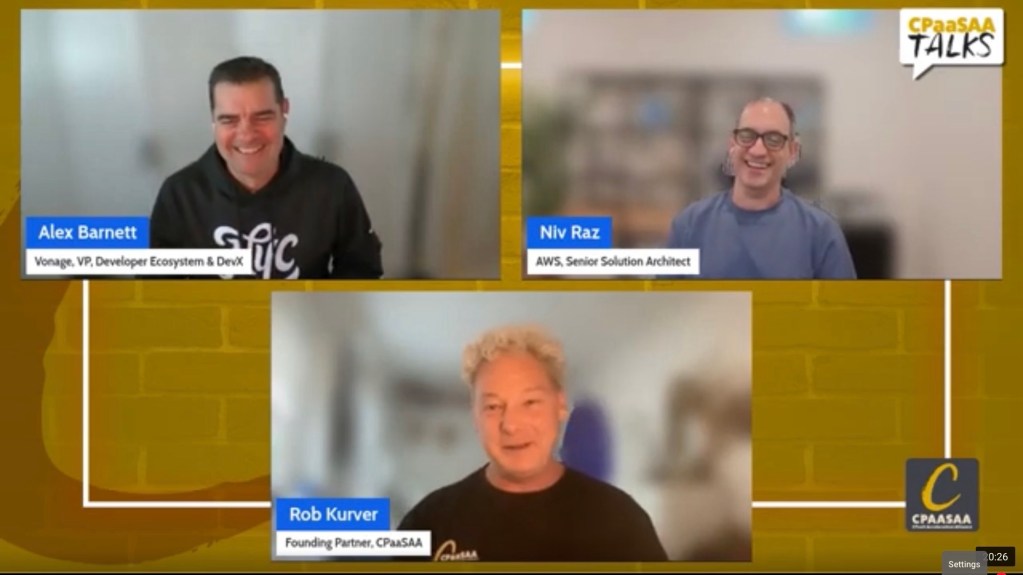
On this week’s CPaaSAA Talk, Alex Barnett (VP Developer Ecosystem and Experience, Vonage) and Niv Raz (Senior Solution Architect, AWS) discussed the Vonage API Power for Kiro — the first CPaaS offered natively inside AWS’s agentic IDE. On paper, a developer-tooling announcement. In substance, something bigger.
Alex put it plainly: for decades, the primary persona of every API business was the human developer. There is now a second, explicit persona — the agent — and Vonage is re-optimizing its entire surface area for it. MCP servers. Machine-readable documentation. Integration patterns taught directly to the AI.
That is not a tooling story. That is a distribution story. And it may be the mechanism that finally converts network APIs from industry ambition into industry usage.
The demand problem, stated plainly
Network APIs have had everything except customers. Standards bodies, working groups, GSMA Open Gateway, CAMARA, aggregation layers, keynote slots at every telecom conference since 2023. What they have not had is meaningful, repeated usage by people solving real business problems.
The reason is structural. The Twilio playbook worked because a developer could send a first SMS in ten minutes, for pennies, at zero stakes — and grow from there. Network APIs offer no equivalent entry rung. They arrive at the top of the stakes ladder: fraud prevention, identity, authentication. High-consequence use cases, procurement-driven buyers, no playground. The industry built the APIs and waited for an adoption curve that could not structurally form.
The question was never how to reach more developers. The question was: through what channel does a network capability reach a business problem?
What changed
Consider what a SIM Swap or Silent Authentication integration used to require. Understand the API, understand telecom identity, navigate the matrix of operators and geographies — or find the aggregator that does. Weeks of specialist work before the first useful signal. Aggregation solved the operator matrix — write once, run across markets. But someone still had to read the documentation and write the code.
Now the integration knowledge lives inside the environment where software is built. On the Talk, Alex was explicit that teaching the agent the correct integration pattern is the core value the Power delivers. Niv described it as removing the integration tax: no context switching, no research phase, no setup ritual. Describe the problem — “flag risky logins on this banking app” — and the network API arrives as part of the answer.
The barrier to network API adoption was never demand for the capability. Every bank wants to stop account takeover. The barrier was the cost of getting from that want to a working integration. That cost has collapsed.
What “developer” now means for the telco community
The word “developer” is doing quiet damage in network API strategy decks, and it is time to retire the old definition.
When a telco executive says “developer,” they picture the Twilio-era persona: a software engineer who reads documentation, evaluates APIs on developer experience, and champions tools bottom-up. The industry has spent three years and real money building portals, hackathons, and evangelism programs for that person.
That person is not disappearing — but as a market segment, they are dissolving. On the Talk, Niv mentioned in passing that three agents were building prototypes for him while we recorded. More code is now written by agents than by humans, and today’s tools are the worst versions of them we will ever see.
This is a live argument in the industry right now — whether telcos need bigger developer communities or better answers for enterprise buyers. The agentic shift resolves it: the two are becoming the same person.
The working definition that should replace the old one: a developer is anyone who can specify an outcome precisely enough for an agent to build it. That includes the traditional engineer, now operating as architect and reviewer. But it increasingly includes the product manager, the fraud lead, the operations owner. The person with the problem is becoming the person who builds the solution.
This completes an argument CPaaSAA has been making across its research: the buyer of network capabilities is the enterprise business owner, not a developer community. The agentic shift converges the business owner and the builder into the same person — and the channel to reach them is not a developer portal. It is presence inside the agentic environments where they work.
Distribution to developers meant documentation. Distribution to agents means being in the context window.
The trust problem that comes with the channel
One admission from the Talk deserves as much attention as the launch itself: Vonage often cannot tell whether an API call originates from an agent or from human-written code. Nor can anyone else — the opacity is industry-wide.
Consider what that means for capabilities whose entire value proposition is trust and verification. Identity APIs are being wired into a channel where the caller’s own identity is unknown. Pricing, security, governance, and liability all run through that gap, and no one has answers yet.
This is precisely where Intelligent Engagement players hold the advantage. The combination of network-level signals and regulated, jurisdictionally anchored trust is not something an agentic platform can replicate — but it must now be extended to a new question: not only “is this end user who they claim to be,” but “who, or what, is calling us?” The providers that answer both will define the commercial layer of the agentic era.
The channel exists. The business model is the work.
For three years, network APIs were a supply-side story: capabilities published, waiting for demand with no way to arrive. The agentic channel is the first credible demand-side mechanism this market has seen — not because agents want APIs, but because agents connect the person with the problem to the network capability that solves it, without the integration tax that stalled every previous attempt.
The pipes are no longer the hard part. Knowing who is on the other end of them is.
We will take both questions further at CASA26 in Amsterdam this September.
Watch the video here: https://youtu.be/Jkye_7z90pk