

How do enterprises evaluate and adopt AI Voice solutions? What are typical approaches and criteria? This extract from CPaaSAA’s report AI Voice: Who Will Run The Conversation? follows previous articles on the ecosystem and telco-native AI Voice. You can download the full report here.
AI Voice buying decisions are not about LLMs
Enterprise adoption of AI Voice is shaped less by model performance and more by practical business considerations.
The report highlights key decision criteria:
- integration with existing systems
- compliance and regulatory requirements
- control over execution and data
- ability to scale and adapt

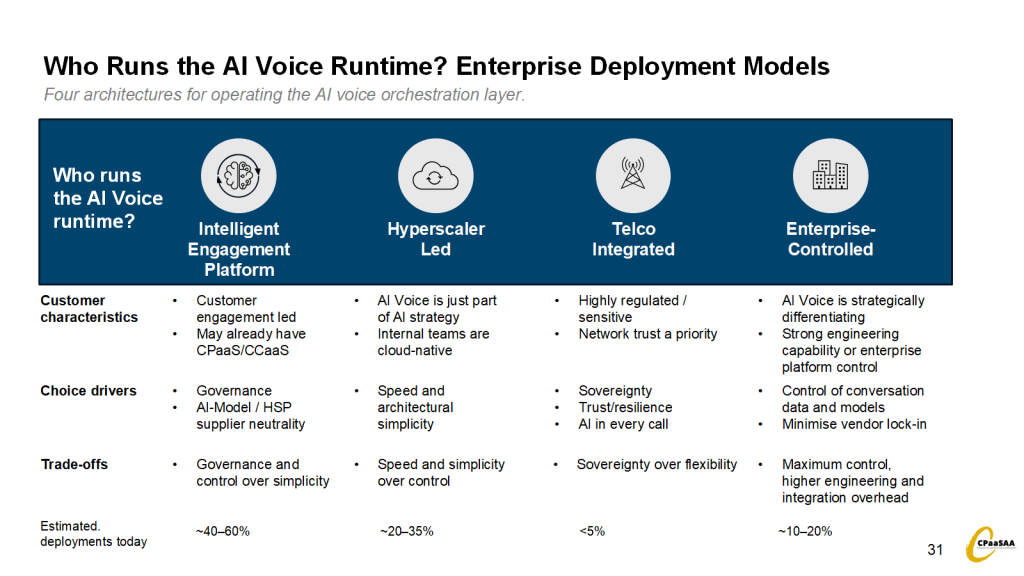
The runtime scenarios diagram above shows how enterprises choose between different deployment models.
It compares:
- Platform-led approaches
- Hyperscaler-led approaches
- Telco-integrated models
- Enterprise-controlled deployments
This matters because the decision determines long-term control.
Headline insight: AI Voice buying decisions are about control of execution, not just capability.
Key drivers of choice
Enterprises evaluate AI Voice through several lenses:
- Compliance and sovereignty requirements
- Cost predictability
- Speed of deployment
- Integration with CRM and workflows
These factors often outweigh technical differences between models.
Implications for suppliers
For CPaaS players:
- Building the Intelligent Engagement narrative is critical to build relevance and demonstrate credibility to customers
- Integration and orchestration are critical
For Hyperscalers:
- Platform depth must be balanced with governance concerns
For Telcos:
- Network capabilities must align with enterprise needs
What’s next?
This article has focused on how customers buy AI Voice.
The next article examines AI Voice: Competitive Scenarios, comparing how different players compete for control.
You can download the full report here.