


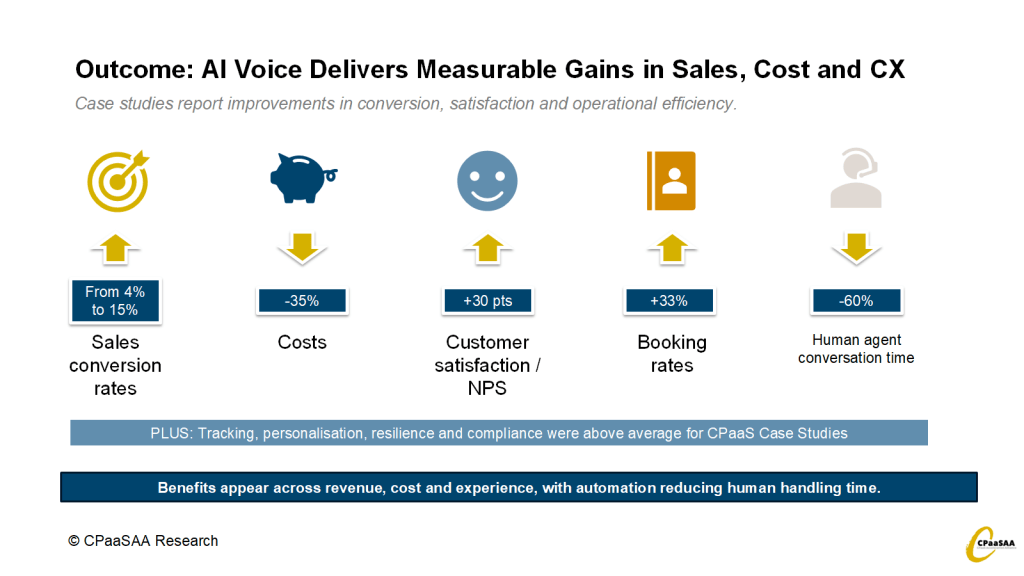
This edited extract from CPaaSAA’s recent report AI Voice: Who Will Run The Conversation gives an overview of business benefits demonstrated by members’ case studies, with highlights of 3x conversion rates, >30% booking conversion rates, time and cost savings, and 60% reduction in conversation times. It is the first of three articles showing the main types of applications in use and the main pattern of customer progression. Part 2 will illustrate typical customer starting points, and Part 3 will explore the deepest value progressions. You can download the full report here.
The benefits of AI Voice applications appear promising from an analysis of the cases in the CPaaSAA Case Directory, which spans a sample of cases from a variety of applications and industry providers.
The chart below shows examples of cited benefits.

Source: CPaaSAA Case Directory.
NB These examples are illustrative highlights observed across case studies, and customers should not expect a point implementation to achieve all of these at once. However, there is a clear pattern of quantified success in many of the case studies we have reviewed.
In common with other data-based tools, strategic benefits such as better tracking and compliance are rated highly for AI Voice.
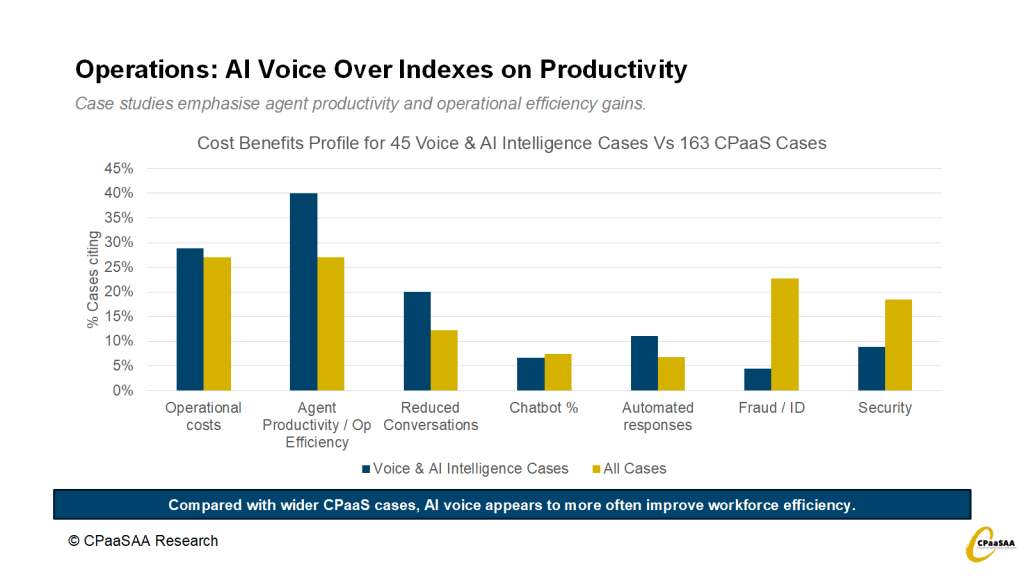
The chart below compares AI Voice benefits to the overall average of Intelligent Engagement cases in our Case Directory. The strongest indexes of quantified business benefits are in reduced conversation times, increased booking rates for appointments, and better lead conversion rates. This is consistent with the narrative of early applications of better call triage using AI Voice, and better availability and first-time call resolution.
Source: CPaaSAA Case Directory
Case Study Distribution
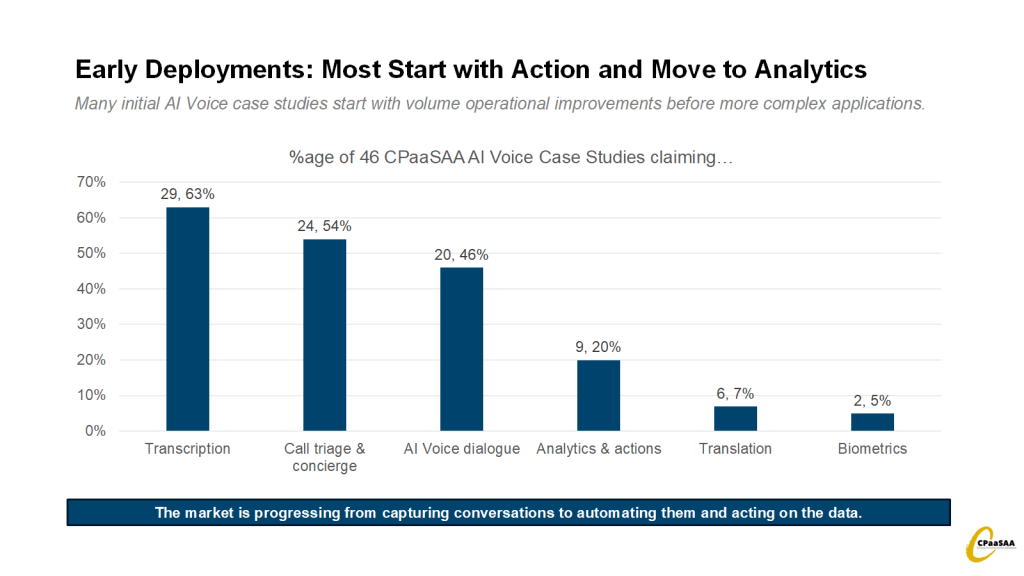
The following chart shows a breakdown of all AI Voice case studies in the CPaaSAA Case Directory (including those shown in the report), and illustrates the profile of usage evolving from transcription as the typical entry point, through to Call triage/concierge-style propositions and increasing sophistication.
Source: CPaaSAA Case Directory
Our research suggests that, coupled with demand factors (to be illustrated in Part 2), supply-side complexity plays a significant part in the evolution of AI Voice. Most customers and providers are currently starting to build on the basics of call transcription and summaries, which are relatively well established and provide the machine-readable data basis on which more complex and automated applications can be run.

Source: CPaaSAA Report, AI Voice: Who Runs The Conversation?
In the next article, we will share examples of how customers typically get started in AI Voice applications, and in Part 3, we will look at where long-term value lies.
Meanwhile, you can download the full AI Voice report here.