


Insights from This Week’s The Inner Circle on Network APIs and the 2026 Inflection Point
The Inner Circle is CPaaSAA’s members-only monthly webinar series, where our analyst team and invited advisory partners share insights, frameworks, and practical guidance to help members navigate what’s next — and translate industry change into real outcomes.
Each session goes deep: data, discussion, Q&A, models, examples, and concrete implications for operators, CPaaS providers, and the wider ecosystem.
This blog is a short public summary of the main themes from this week’s The Inner Circle session with Raul Castañon (S&P Global Market Intelligence), who shared early findings from S&P’s 2025 5G Infrastructure Survey and linked them to live Network API deployment data.
Inside the member community, the full session includes:
- detailed survey data and confidence ranges,
- the priority vs deployment quadrant analysis,
- phased adoption timelines through 2028,
- implications for operators, CPaaS players, and enterprises,
- and a candid discussion on costs, constraints, and monetisation realities.
What follows here is a public glimpse into a much deeper, members-only conversation about where Network APIs are truly heading — and why 2026 matters more than most people realise.
The debate misses the real issue
Some say Network APIs are finally taking off. Others argue they’re still stuck in pilots. Both views oversimplify what’s actually happening.
In a recent CPaaSAA Inner Circle session, we reviewed fresh data from S&P Global Market Intelligence’s 2025 5G Infrastructure Survey, combined with live deployment data from GSMA Open Gateway. What emerged wasn’t a hype story, but a much more grounded execution story.
Infrastructure reality still sets the pace
The main constraint is not lack of ambition. It’s infrastructure reality.
Most operators are still operating on 5G Non-Standalone architectures. That means truly advanced, deeply programmable Network APIs will take time to scale. This isn’t failure — it’s physics. The mistake is pretending that all APIs move at the same speed.
Foundational APIs are already becoming real
This doesn’t mean Network APIs are stalled.
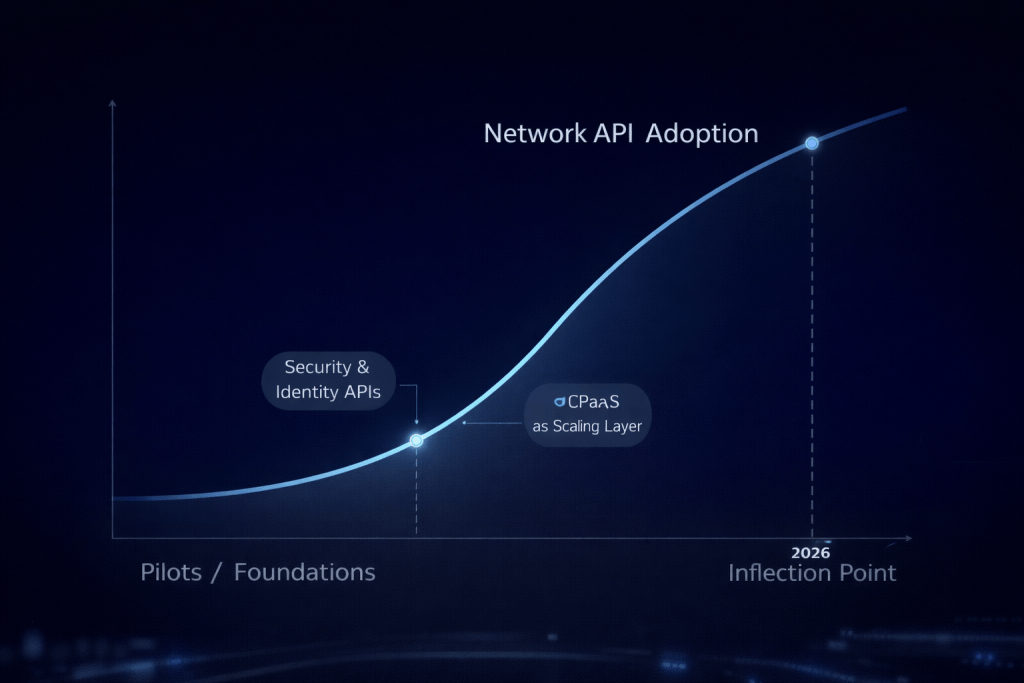
Foundational APIs — especially around security, identity, and fraud prevention — are already being deployed and commercialized. In fact, just two APIs account for the majority of live deployments today, and they also rank highest in operator priorities.
That alignment between intent and execution is rare in telecom — and it matters.
Why 2026 is the real inflection point
The data points to 2026 as a genuine turning point. Not because everything suddenly becomes “advanced,” but because the market shifts from experimentation to operational commitment.
More than half of operators expect to have at least one commercially deployed Network API by then. Once that threshold is crossed, “wait and see” stops being a neutral strategy.
CPaaS is emerging as the scaling engine
One of the quieter but more important shifts is the role of CPaaS providers.
Rather than waiting for universal operator readiness, CPaaS platforms are abstracting fragmentation, managing fallback logic, and selling outcomes to enterprises that don’t want to think about networks at all. In practice, this is how adoption actually scales.
What this means for the ecosystem
The winners in this market won’t be those with the largest API catalog or the boldest vision slides. They’ll be the ones who sequence ambition correctly, commercialize what already works, and reduce friction before adding complexity.
We unpack the data, the implications, and the uncomfortable trade-offs in detail in our member-only analysis — including what this means for operators, CPaaS providers, and enterprises between now and 2028.
If you want to help shape that conversation rather than react to it, that’s what the Alliance is for. Contact us if you’re interested!