

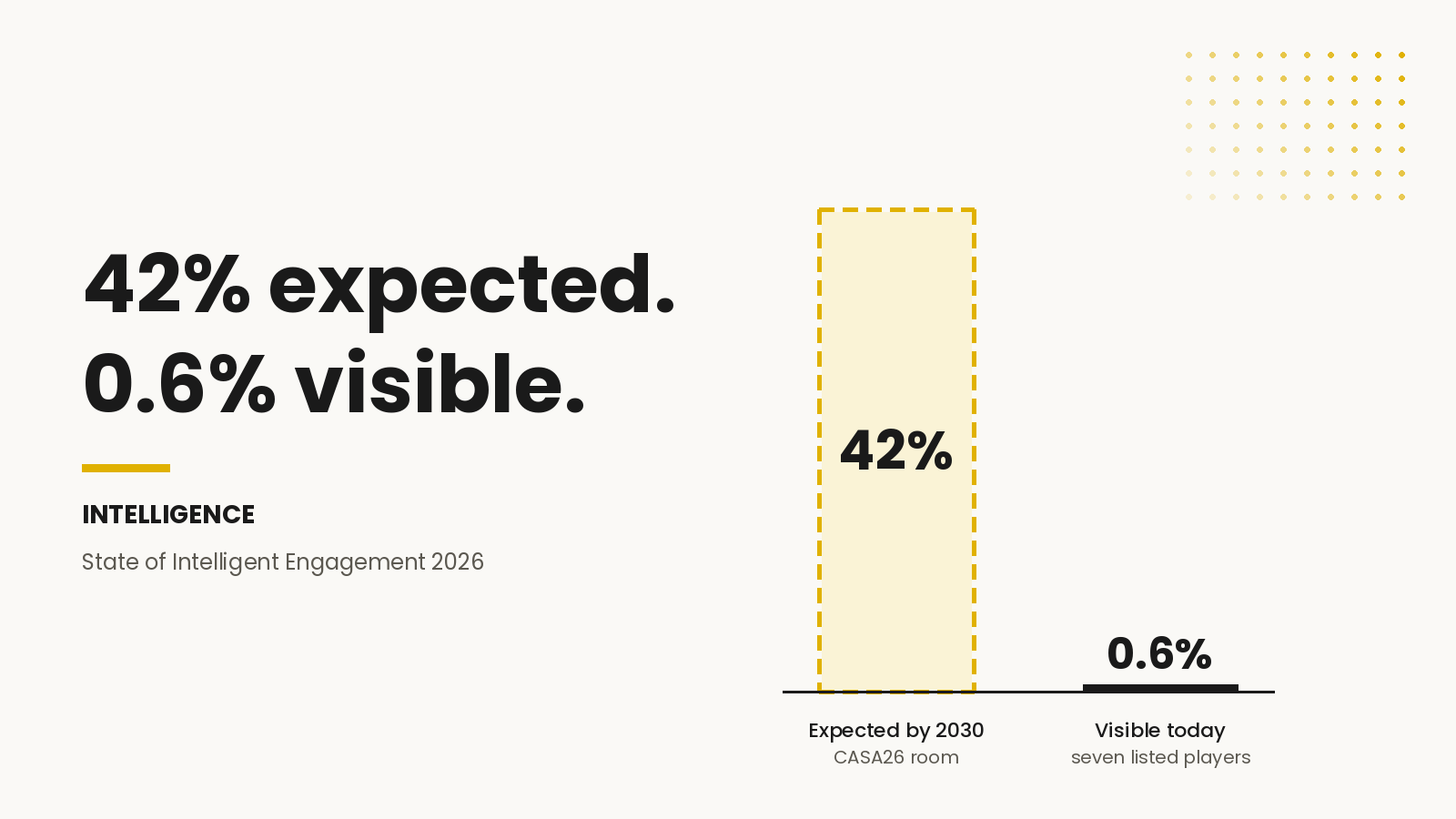
In Amsterdam on 22 September, the CASA26 room was asked what share of revenue intelligence adds today, and what it will add by 2030. The weighted average moved from 11% to 42%. In 2026 most votes sat under 5%. By 2030 most sat between 20% and 60%.
The State of Intelligent Engagement 2026 report then set that against the accounts. Three years of results from seven listed players: four messaging-led (Twilio, Sinch, Bandwidth, Route Mobile) and three voice-led (RingCentral, Five9, 8×8), with combined revenue of about $13.5bn. Separately identifiable intelligence revenue came to about 0.6%. Only one of the seven reports AI revenue as such.
Two numbers that measure different things
The 42% is an opinion: a weighted average of what 39 senior people expect, calculated from response ranges. The 0.6% is an accounting fact: what companies currently choose to show. Neither is wrong, and the report is explicit that the two figures measure different things. The true figure is probably higher than 0.6%, because most companies do not report intelligence separately.
But the gap does not close just by allowing for that. Four in five participants also expected intelligence to earn a better margin than transport. Blended gross margins across the same seven players have sat at about 50% for three years. Gross profit is growing with volume. There is no visible uplift in it yet.
If intelligence cannot be counted, it cannot be defended
Here is the part more interesting than the gap itself. The industry has no agreed definition of intelligence revenue. Five9 reports AI revenue as a share of subscription revenue. RingCentral reports the share of recurring revenue from customers who buy at least one paid AI product. Both are firsts, and both deserve credit for being on the record. They are not measuring the same thing.
That matters well beyond reporting. A boardroom cannot set a target for something it cannot define. An investor cannot value what two companies disclose on different bases. A customer cannot be asked to pay for something the supplier cannot point to. When four in five people in the room believe the margin is coming, the first job is to make it visible.
The report sets out a draft definition for discussion: AI agents and copilots, AI processing such as speech-to-text and analytics, orchestration, governance, the conversation record, and applied know-how or deployment expertise. It is a starting point, and CPaaSAA would like it argued with.
What gets tracked next
Whether the gap is timing, optimism or both is one of the measures CPaaSAA will track over the next twelve months. The first step needs no forecast and costs nothing: agree what to count.
What you cannot count, you cannot price. Which of your own numbers would you show your board today?
Researched and written by Andrew Collinson of Connective Insight, commissioned by CPaaSAA.

I've spent my career in IT and telecoms building bridges, from the early days of cloud communications to today's reset around APIs, CPaaS and AI.
As Founding Partner of The Next Cloud and CPaaSAA, I help telcos, CPaaS players and AI-native scaleups work out where they fit in the AI era, through strategy, ecosystem building and events.
My view: the value is moving from platforms to outcomes, and real innovation comes from ecosystems, not incumbents acting alone.
Based in Amsterdam, usually somewhere else.
Comments are closed