

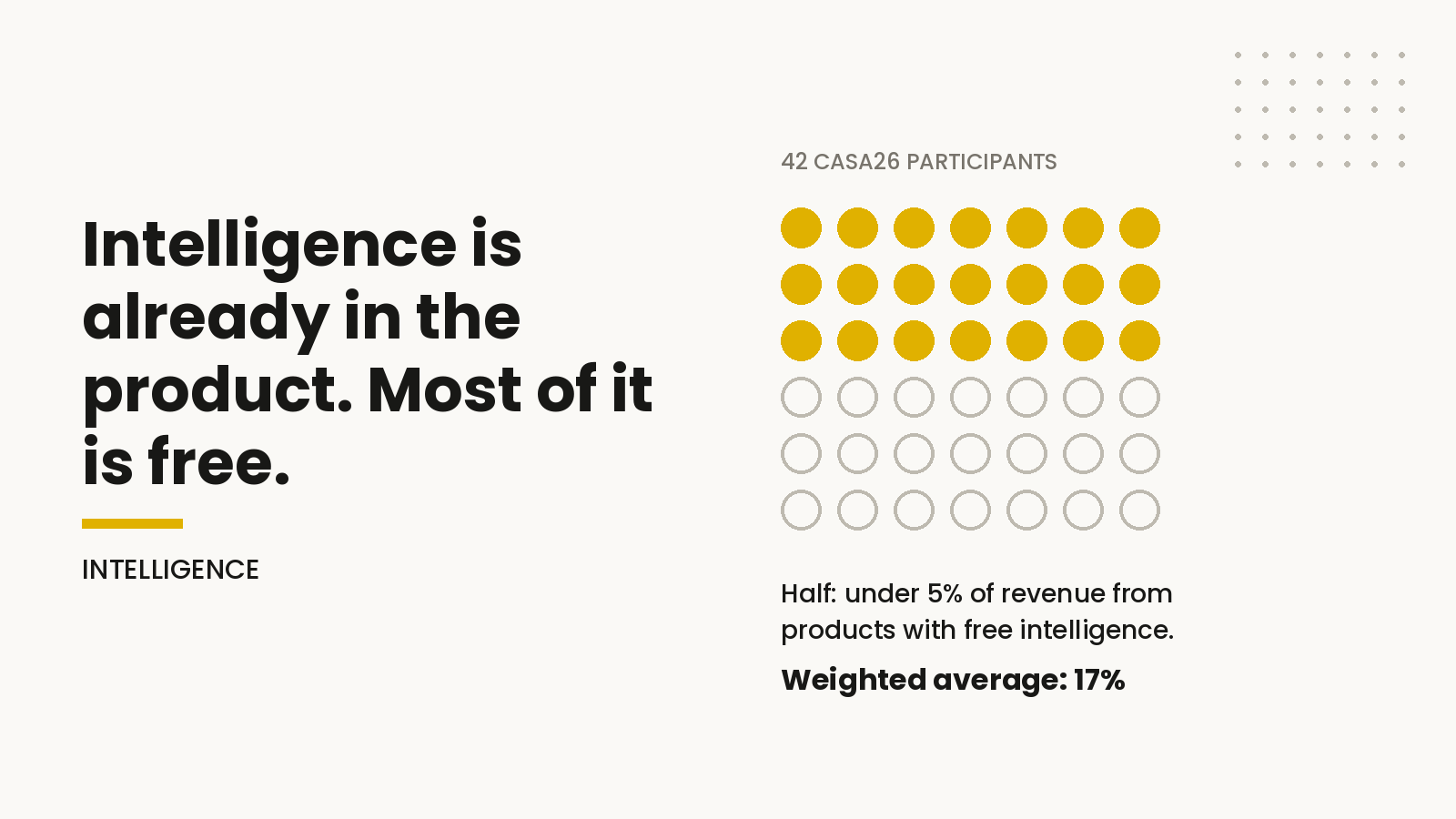
At CASA26 we asked a simple question: what share of your revenue today comes from products that now include intelligence at no extra charge? Half of the 42 participants who answered said less than 5%. The weighted average came out at 17%.
Read that carefully, because it is not the same as the 42% headline. This is not revenue from intelligence. It is revenue from products that have intelligence quietly built into them, with nothing added to the price. The report puts it plainly: intelligence is already in the mix, but most of it is not yet charged for.
Free is how a feature becomes an expectation
There is nothing irrational about it. A summary, a transcript, an AI receptionist or a smarter routing rule is easy to add to a product and easy to justify as keeping the customer. Every supplier does it because the supplier next door does it. The risk is what happens next. A capability that has been free for a year is not a premium feature when you try to price it. It is a missing feature when you take it away.
The pricing panel at CASA26 went straight at this. Chaired by Žiga Lešnik of Simon-Kucher, with Ricard Chramer of Meetric, Daniel Morris of Sinch and Adnan Saleem of Radisys, it asked how to move customers beyond free AI features. The advice was short: differentiate, have an entry model and stay flexible. Asked how to avoid commoditisation, the broad answer was to keep moving.
Where members measure it, AI pays
The evidence that customers will pay is also in the report. Crexendo describes its CAIRO product as delivering roughly $120 of incremental revenue per account per month, an uplift of about 35% on average telecom customer revenue. Gamma reported in March 2026 that a German AI voice agent was generating roughly €50,000 a month and growing at about 30% month on month. Five9 reported AI revenue of $39m in its second quarter of 2026, up 78% and now 15% of subscription revenue against 9% a year earlier, on a basis that widened during the series. These are company figures, and the report treats them that way.
They have something in common. In each case the intelligence is a distinct product with its own name and its own number. That is the difference between 17% bundled and revenue that can be counted.
The question is the billing unit
The signposts in the report point to the next fight. One company claims about €5 of voice revenue per user against more than €50 per digital employee. Another sells sessions rather than seats and claims savings of 40 to 50%. Whether the industry reprices upward per agent or deflates per session is one of the things to watch.
So the industry may not have a demand problem. It may have a packaging problem: intelligence is shipped faster than it is priced. The first player in each segment to give it a name, a price and a number is the one who gets to count it.
The evidence behind these numbers, and the four scenarios they feed into, is in The State of Intelligent Engagement 2026.
Researched and written by Andrew Collinson of Connective Insight, commissioned by CPaaSAA.

I've spent my career in IT and telecoms building bridges, from the early days of cloud communications to today's reset around APIs, CPaaS and AI.
As Founding Partner of The Next Cloud and CPaaSAA, I help telcos, CPaaS players and AI-native scaleups work out where they fit in the AI era, through strategy, ecosystem building and events.
My view: the value is moving from platforms to outcomes, and real innovation comes from ecosystems, not incumbents acting alone.
Based in Amsterdam, usually somewhere else.
Comments are closed