

Put yourself in the seat of a product lead at a pan-European bank. You have read the press releases. Number Verification is live across the continent, according to the announcements. You ask your partners where you can actually switch it on next quarter, on the same specification, everywhere. The answer is a lot shorter than the press releases.
Mobile Network APIs: Signals of Value measured that gap. Across 82 countries holding about 90% of the world’s mobile connections, it traced what named sellers actually offer, operator by operator. The result is a staircase, and every step down is a reason for a buyer to wait.
Four numbers, four different markets
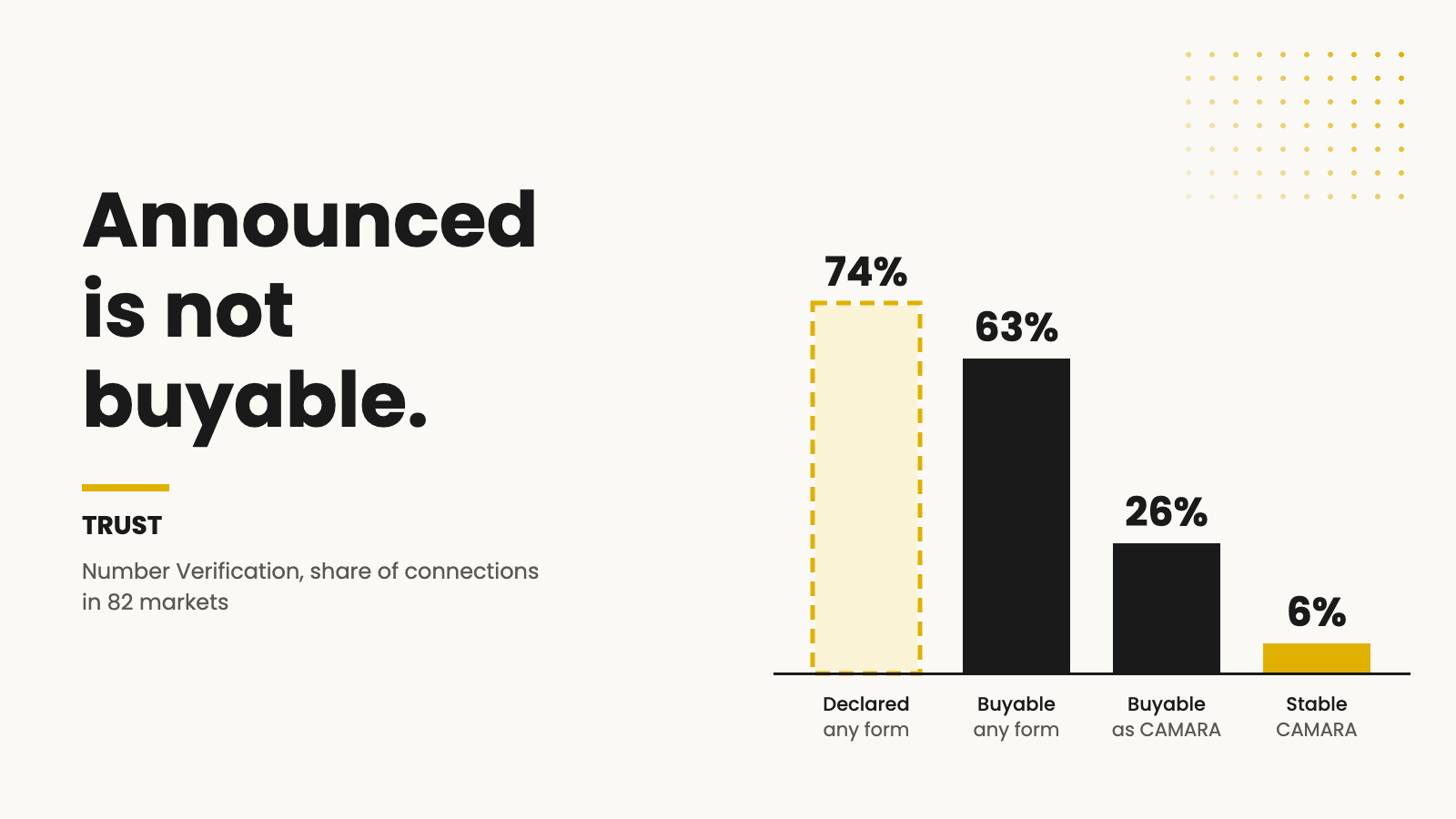
Number Verification has been declared in some form for 74% of connections. It can be bought in some form for 63%. It can be bought as CAMARA, the industry’s shared specification, in any version, for 26%. And it can be bought on a stable CAMARA version, 1.0 or above, for 6%.
Each number is true. They describe very different markets. The first is the market as the industry talks about it. The last is the market a buyer who wants one consistent integration can actually build on.
The same pattern shows on the standard itself. CAMARA Number Verification has been announced as CAMARA or Open Gateway for 59% of connections, but can be bought as CAMARA for 26%. Less than half of what has been announced has turned into something a buyer can order.
Buyers plan on the bottom step
A buyer does not need coverage in the abstract. It needs enough of its own customers to be reachable, with an offer it can check and a product that behaves the same wherever it is bought. When the industry leads with the declared figure and the buyer discovers the buyable one, the gap does not just slow the deal. It costs credibility for the next one.
None of this means the work has failed. Getting from announcement to a stable, sellable product across hundreds of operators is hard, and the trend is in the right direction. But the industry is selling the top of the staircase while buyers stand at the bottom.
Publish what can be bought, not what has been promised
The fix is not complicated. Talk about buyable coverage, publish it where a buyer can check it, and be specific about which version is on offer where. A smaller number that is true builds more confidence than a bigger number that falls apart in procurement.
Buyer coverage maps are one of the further outputs CPaaSAA plans to produce from this research. Members will help decide which come first.
Announced is a promise. Buyable is a product. Only one of them closes deals.
The public edition of Mobile Network APIs: Signals of Value is free to download. The Detailed report, with Number Verification and SIM Swap coverage country by country and how it was measured, is included in CPaaSAA membership. Non-members can buy it from the same page.
From Mobile Network APIs: Signals of Value, researched and written by Andrew Collinson of Connective Insight, commissioned by CPaaSAA.

I've spent my career in IT and telecoms building bridges, from the early days of cloud communications to today's reset around APIs, CPaaS and AI.
As Founding Partner of The Next Cloud and CPaaSAA, I help telcos, CPaaS players and AI-native scaleups work out where they fit in the AI era, through strategy, ecosystem building and events.
My view: the value is moving from platforms to outcomes, and real innovation comes from ecosystems, not incumbents acting alone.
Based in Amsterdam, usually somewhere else.
Comments are closed