

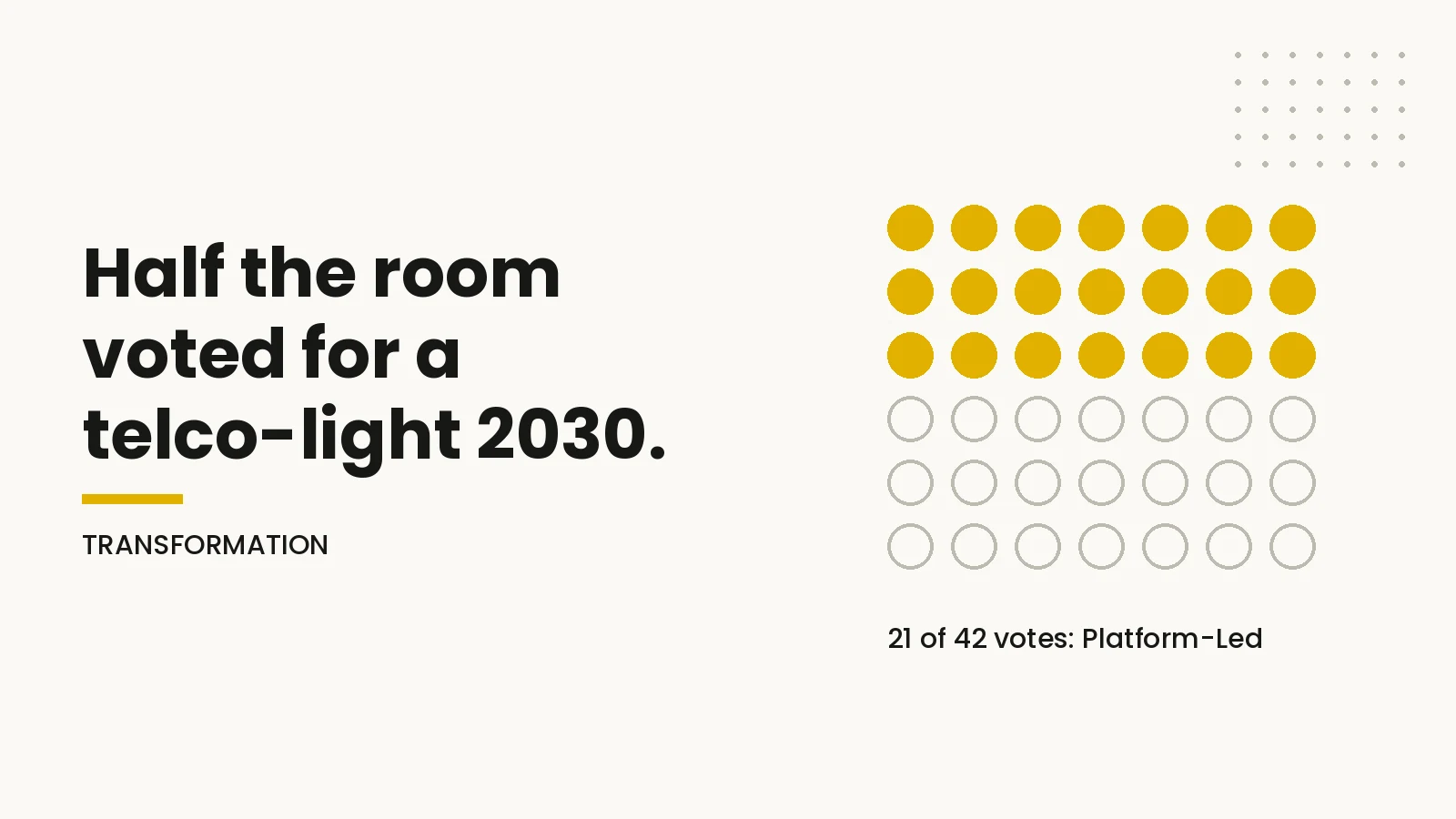
The chart is easy to read from across a room. Four blocks, sized by votes, and one of them is far bigger than the others. Of 42 votes at CASA26, 21 went to Platform-Led Intelligent Engagement. Full Intelligent Engagement took 12, Absorbed Engagement 5 and Wholesale Signals 4.
Add the blocks across and two things stand out. Almost four in five votes expect this industry to capture the intelligence value. And three in five expect a telco-light market, one where telco-originated services such as SMS, RCS and network APIs carry a shrinking share of engagement revenue. Participants put that share at about 70% today and 42% by 2030, on a weighted average. These are opinions, not forecasts, but the direction was clear: at least three in four expected it to fall.
Telco-light is not telco-absent
It is tempting to read that as bad news for operators. The scenario says something more precise. In Platform-Led, platforms thrive on WhatsApp, on blended identity products and on their own AI Voice stacks, while operators supply excellent transport and identity signals wholesale and are paid for them. The paid role is real. What changes is the size of the share and the position in the value chain.
The votes also carry a second signal. A third of participants expected telco-integrated models to lead in AI Voice, and the routes are already live: KPN with ElevenLabs, Radisys’s V.AI ecosystem for operators, and Alianza’s Crux. A telco-light engagement market and an operator foothold in AI Voice are not contradictory. They are the same scenario, seen from two layers of the stack.
The vote is a timing question as much as a scenario question
Amy Cameron of STL Partners explained her own vote at the closing panel: she chose Platform-Led because 2030 is probably too early for operators, though 2035 might not be. That is worth holding on to. A telco-light 2030 is consistent with a stronger operator position later in the decade, if operators are in place before the runtime market settles.
Nick Lane of Mobilesquared and Kaleido Intelligence set out the conditions. Operators stay central if they isolate SMS, rebuild trust, reposition RCS around engagement and scale network APIs as a standalone platform. If they carry legacy SMS economics forward, he warned, they risk becoming dumber pipes.
A wholesale role only counts if someone pays for it
Network APIs are the clearest test of that wholesale role, and it is the question behind CPaaSAA’s new research, Mobile Network APIs: Signals of Value, which Andrew Collinson has published this week. It looks at where the signals of value are showing up. The public edition is free to download. A fuller member edition is available to CPaaSAA members, or on enquiry.
What decides it
Absorbed Engagement, which 12% chose, is the scenario where engagement turns into a feature inside someone else’s stack. The closing panel raised one way it could happen: a messaging app brings AI voice to business conversations before anyone else does. The panel did not settle that question, and it is why timing matters.
So the vote does not tell operators to wait. Half the room is telling them where the value will sit, and a third is telling them there is still a place in it. The positions that count are being taken now.
Researched and written by Andrew Collinson of Connective Insight, commissioned by CPaaSAA.

I've spent my career in IT and telecoms building bridges, from the early days of cloud communications to today's reset around APIs, CPaaS and AI.
As Founding Partner of The Next Cloud and CPaaSAA, I help telcos, CPaaS players and AI-native scaleups work out where they fit in the AI era, through strategy, ecosystem building and events.
My view: the value is moving from platforms to outcomes, and real innovation comes from ecosystems, not incumbents acting alone.
Based in Amsterdam, usually somewhere else.
Comments are closed