
Sinch, a CPaaSAA Accelerate member, just published research that validates — and sharpens — an argument this alliance has been building for the better part of a year.
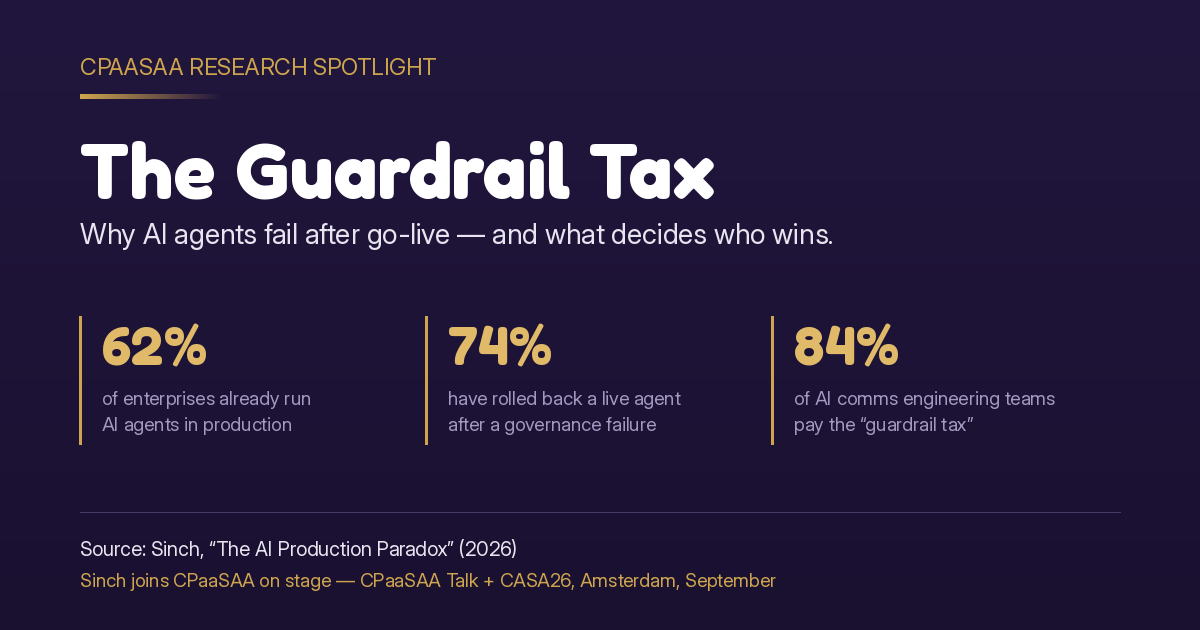
The AI Production Paradox surveyed 2,527 senior decision-makers across ten countries and six industries. The headline is startling on its own: 74% of enterprises have already been forced to roll back or shut down a live AI customer communications agent because of a governance failure. Deployment isn’t the barrier anymore — 62% already have agents in production, 88% will within twelve months. What breaks is what happens after go-live.
Governance was supposed to be the fix. It isn’t.
The uncomfortable finding sits inside the rollback number itself. Among organizations with the most mature governance frameworks, the rollback rate doesn’t fall — it climbs, to 81%. Sinch’s Chief Product Officer Daniel Morris reads this correctly: better monitoring surfaces failures other teams simply don’t see. The teams with the least visibility into their own systems aren’t succeeding. They’re blind.
That’s the finding that should stop every telco and CPaaS commercial leader mid-scroll. The industry has spent two years selling guardrails as the answer to trust. The data says guardrails alone don’t move the needle — because they’re being bolted onto infrastructure that was never built to carry them.
The guardrail tax is the missing middle, priced
Morris calls the resulting drag the “guardrail tax”: 84% of AI communications engineering teams now spend at least half their time building and maintaining safety systems that, in a healthier stack, the communications infrastructure itself should provide. 75% of enterprises now rank investment in trust, security and compliance above investment in the AI itself (63%) — governance has become the top-ranked investment priority in enterprise AI programs, and it still isn’t closing the gap. Credit where it’s due: this is exactly the kind of research the AI Voice conversation has been missing — large-scale, rigorous, and honest about what production actually looks like. Sinch has done the ecosystem a real service by putting hard numbers on a problem most vendors would rather not quantify.
What this adds to the AI Voice thesis
CPaaSAA’s own research, AI Voice: Who Will Run the Conversation?, argued that value in AI Voice shifts from carrying interactions to orchestrating the intelligence that runs them, and that controlling the runtime determines where the value is captured. Sinch’s findings are the operational proof of that thesis: the organizations winning aren’t the ones with the most guardrails, they’re the ones with the highest infrastructure satisfaction — which Sinch’s analysis found to be the single strongest predictor of deployment success, full stop. It’s also the same signal coming through everything published across this community in recent months. At RAISE Summit in Paris earlier this month, the pattern was visible from the other side: an AI world shipping software ten times faster while security issues climb 108% year on year — all the speed, none of the production discipline enterprises actually need. Sinch’s rollback numbers are what that gap looks like on an enterprise P&L. Our Inner Circle session on why Voice AI is stress-testing the enterprise stack and the recent CPaaSAA Talk with Radisys — The Call Is the New Platform — reached the same conclusion from inside the industry. Different rooms, different vantage points, one answer: the infrastructure underneath the conversation is where the contest is being decided.
Put plainly: the runtime layer isn’t a nice-to-know for CTOs. It’s the commercial variable that decides whether an AI Voice deployment survives contact with production.
Where this goes next
The full Production Paradox report — with regional and vertical breakdowns — is out now, and it’s a genuinely valuable starting point for anyone serious about running AI Voice at scale. We’re doubling down on it: a CPaaSAA Talk with Sinch is coming soon, where we’ll dig into the findings live with members, and Sinch will be with us as a sponsor at CASA26 in Amsterdam this September, where the AI Voice conversation continues on stage. If you’re building or buying AI Voice infrastructure right now, the question this data leaves you with is simple: is your engineering team building the next customer experience, or still paying down the guardrail tax on the last one?
CASA26. Amsterdam. September. Be there.

My lifetime in IT and telecoms has been dedicated to innovation, building bridges and creating change. From the early days of cloud communications to working with operators on innovations and business development, and currently emphasizing APIs, CPaaS/CX and AI, my journey has been one of continuous evolution.
As founding partner at CPaaS Acceleration Alliance and The Next Cloud I'm privileged to help global telcos and techcos thrive in a fast changing world - through events, community building, strategy and global business development. I thrive on challenges and change, strategizing in cloud communications, and bringing people together for mutual success. Travel and continuous learning are my passions.
I believe the global communications industry is pivoting to prioritize customer experience and impactful solutions over mere technology and platforms, and we can tackle societal challenges by merging the strengths of corporates and innovators within new ecosystems.
Comments are closed