

Last week, the company that hired the man who co-wrote SIP decided SIP wasn’t the point anymore.
On 29 June, Five9 — a CPaaSAA member — completed a leadership transition that had been building quietly for months. A new chief technology officer, a new chief sales officer, a new EVP for transformation and strategy. Jonathan Rosenberg — a foundational figure in the protocols that made internet voice possible — moves to an advisory role. He follows a new CEO, Amit Mathradas, in since February, and a new chief marketing and growth officer, Jay Lee, in since April. In the space of five months, the communications-native leadership that built Five9 has been replaced, almost wholesale, by operators whose pedigree is enterprise software, AI automation, go-to-market discipline and corporate development.
It’s worth pausing on what is being stepped away from. Mike Burkland took Five9 from roughly $10 million in revenue to more than a billion — from around 80 people to 2,000 — across two decades. That isn’t a turnaround. It’s one of the defining builds in the history of cloud communications. To climb off the top of a mountain like that, deliberately, so a different kind of team can set out for a different summit, takes more nerve than most incumbents can find. We admire it — and we suspect it was not an easy decision for anyone involved.
When the contact centre becomes a feature
Because here is the uncomfortable thing the move says out loud: the contact centre, as a category, is dissolving into AI.
For twenty years, the value of a CCaaS platform sat in things like skills-based routing, workforce management, queue logic and the careful integration of one tool to the next. Those were hard problems, and solving them well was a real business. They are now, increasingly, features of a model rather than products in their own right. Routing, summarisation, sentiment, even the emotion-detection capabilities the industry made such a fuss about a few years ago — these are becoming table stakes that AI performs natively. When that happens, the platform layer commoditises, and the value migrates up a predictable arc — from the connection, to the conversation, to the intelligence built on top of it, and finally to the action that intelligence can take. That last step is the one that matters. Understanding what a customer wants is becoming cheap; completing the request — reaching into the systems where the work actually happens and closing it out without a human in the loop — is not. Connectivity remains essential. It is simply no longer where the margin lives.
This is the same gravitational pull we mapped in our AI Voice: Who Will Run the Conversation? research — the profit pool in communications shifting away from carrying interactions and towards orchestrating the intelligence that runs them. Five9 is now the most visible public company in our space living that thesis out in real time.
Three routes, one destination
The instructive comparisons are its two great rivals — and both are moving in the opposite direction to Five9. NICE replaced its own legendary CEO, Barak Eilam, with former SAP leader Scott Russell, then spent just under a billion dollars on Cognigy to bring conversational AI into the core of its platform. Genesys has gone further still: fresh from a $1.5 billion investment by Salesforce and ServiceNow, it acquired the agentic-workflow company Pinkfish the day after Five9’s own reshuffle — buying not the conversation but the execution, the ability for an AI agent to reach across CRM, ERP and billing systems and complete the work end to end. Two of the biggest names in the category are buying their way to the intelligence layer: NICE reached for the conversation, Genesys for the action behind it.
Five9 is making a conspicuously different bet. Rather than acquiring the intelligence, it is rebuilding the company — its leadership, its narrative, its go-to-market — around the claim that it can become an intelligence company itself. Where NICE and Genesys are betting the balance sheet, Five9 is betting the org chart. Jay Lee’s mandate is explicitly that repositioning: brand, story, messaging, channels and sales, all reoriented from “cloud contact centre” to AI-led customer experience.
Why does the framing matter so much? Because the framing is the valuation. A communications business is priced on free cash flow. An intelligence business is priced on something far more generous — growth, optionality, the size of the prize. Swapping a communications-native C-suite for software, AI and corporate-development leaders is not only an operational change. It is a deliberate re-rating of the story the market is being asked to price. Whether the underlying product re-rates with it is the question the next twelve months will answer.
To the new team’s credit, the repositioning is not only narrative — the substance is showing up in the platform. In January, Five9 deepened its partnership with Google Cloud, pairing its own platform with Google’s Gemini models rather than pretending to build the frontier itself: a clear-eyed answer to the “what runs where” question. In March, it relaunched Five9 Fusion as a formal partner program — an open orchestration ecosystem of ISVs, integrations and embedded technologies, positioned explicitly as the connective tissue of the enterprise CX stack. That second move is the more telling one. A contact centre is a destination; connective tissue is a control point. Fusion is Five9 trying to stop being an app you buy and start being the layer everything else plugs into — which is precisely where durable value sits once the apps themselves commoditise. It is the same instinct CPaaSAA keeps returning to: in the AI era, the orchestration layer is the prize.
The bridge they kept
There is one telling point of continuity in all this — and it reframes the whole story. The one senior leader the new regime chose to keep is the chief product officer, Ajay Awatramani, and he is a more interesting survivor than he first appears. Awatramani is Five9’s first-ever CPO, appointed in October 2024; the company created the role specifically to put product and AI at the centre of its strategy, and his brief from day one described the ambition to become the orchestration engine for every customer interaction. He was hired by Burkland and kept by Mathradas — the bridge between the old world and the new. Which means this was not a leadership change that happened in June. It began with product more than eighteen months ago, and everything since — the CEO in February, the growth chief in April, the technology, sales and strategy team in June — has been the rest of the house rebuilt around that core. You change the story and the go-to-market quickly; you change the product carefully, and Five9 started early. That its product chief arrived from a venture seat, advising investors on AI startups, only sharpens the point: the one survivor at the helm thinks in bets.
The system of activation
For the wider Intelligent Engagement ecosystem, this is the conversation underneath the conversation. The industry has talked for two years about becoming “AI native,” but very few players can say concretely what that means or how they get there. The analyst Dave Michels of TalkingPointz has made the sharp observation that, across enterprise communications, leadership change has been the first visible symptom of the AI wave — Five9, NICE, Verint and Cisco’s Webex team all turning over their senior ranks in the space of a year or so — and that the theme tying the churn together is orchestration. A striking number of those players have answered the wave with the same move: reshuffle the leadership and hope the narrative follows. Five9’s version is more coherent than most, because it is honest about the underlying logic. The argument is no longer system of record versus system of engagement. It is whether communications can become the system of activation — the layer that turns a live conversation into understanding, and understanding into action — and capture the value of doing so.
That value is real, and it is specifically a communications company’s to capture: privileged access to voice, the ability to build intelligence on the conversation as it happens, and the trust and regulatory standing that come from operating as a communications provider rather than a generic software vendor. But capturing it raises questions that sit right at the centre of CPaaSAA’s agenda — cost-effectiveness and which models run where, sovereignty and data residency, and the deceptively simple identity question every player in this space now has to answer: are you a communications company, or an IT company — or, the newest version of the question, an AI company? At Five9’s own analyst event last autumn, Awatramani answered without hesitation: Five9, he said, will be an AI company, full stop. Dave Michels pushed back at the time, reserving that label for the handful of firms that actually build the models rather than the many that deploy them — while granting, fairly, that the claim if anything understated how far ahead Five9 already was on AI-first CX. That exchange is the identity question in miniature, and it matters because each answer is governed, valued and trusted differently. Settling it in the market’s mind is, in large part, what the new leadership has been brought in to do.
The habit, not the event
Five9 has just placed its bet on the answer, in public, ahead of most of the field. But none of this is a finish line. Changing the leadership and the story is an event; becoming — and staying — an intelligence company is a habit. The models keep moving under everyone’s feet, which means a single re-rating won’t hold on its own. It has to be backed by a steady cadence of bets: new integrations, selective acquisitions, and the appetite to run small experiments at the edges of the platform long before they are safe enough to put on a roadmap. The players who win the intelligence layer won’t be the ones who repositioned once. They’ll be the ones who made innovation continuous — a portfolio of small wagers, most of which won’t land, a few of which will define the next decade.
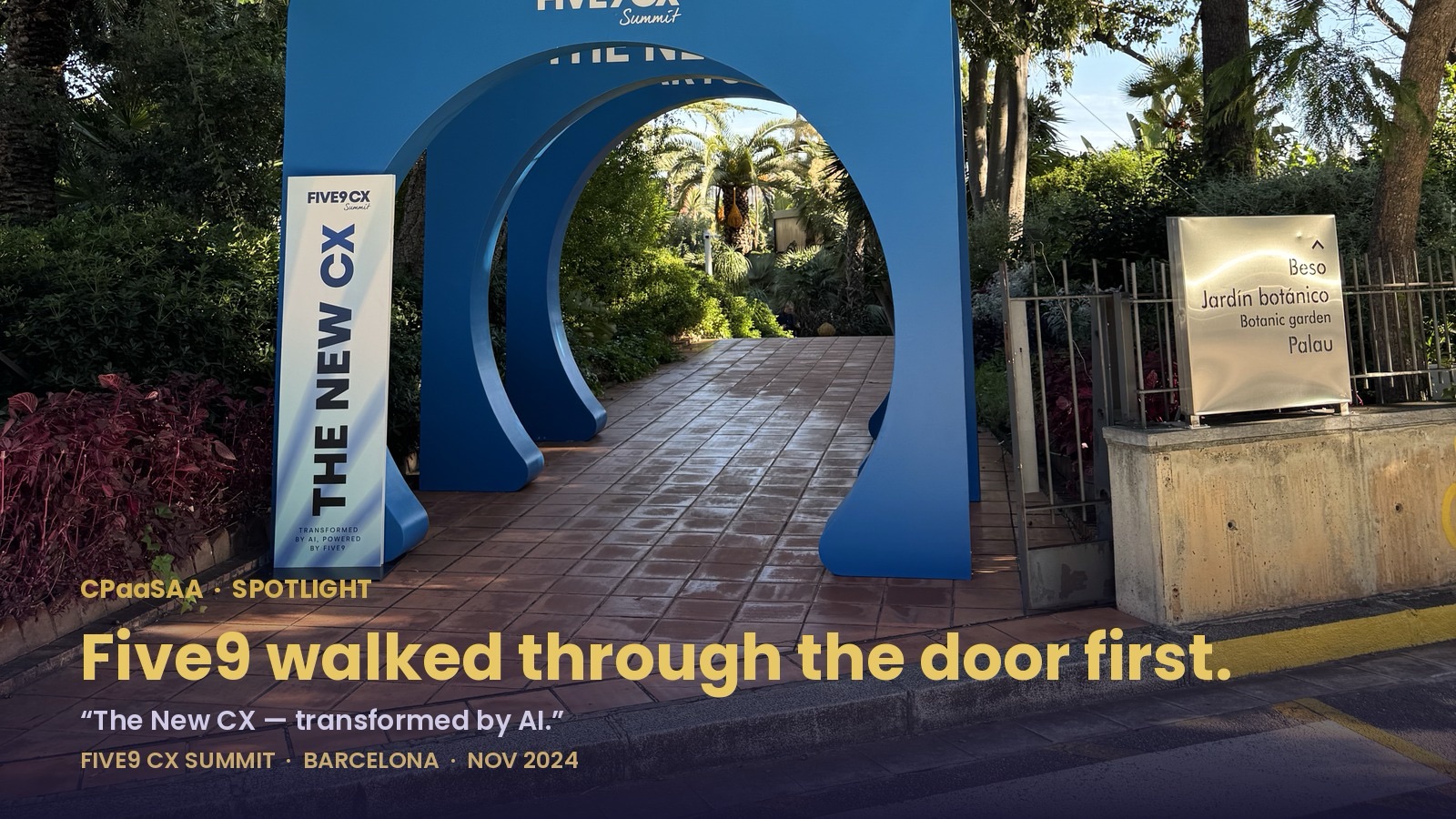
So the transition will be watched closely, and not only by Five9’s competitors. Every Intelligent Engagement player — telco, CPaaS platform, CCaaS or CRM leader — is standing in front of the same door. Five9 has simply chosen to walk through it first, with the lights on.
We wish them well, and we’ll be watching with more than passing interest.
Five9 is a member of CPaaSAA. This Spotlight reflects CPaaSAA’s own analysis and is offered in the spirit of an ecosystem thinking out loud about a shift we are all living through.

I've spent my career in IT and telecoms building bridges, from the early days of cloud communications to today's reset around APIs, CPaaS and AI.
As Founding Partner of The Next Cloud and CPaaSAA, I help telcos, CPaaS players and AI-native scaleups work out where they fit in the AI era, through strategy, ecosystem building and events.
My view: the value is moving from platforms to outcomes, and real innovation comes from ecosystems, not incumbents acting alone.
Based in Amsterdam, usually somewhere else.
Comments are closed