

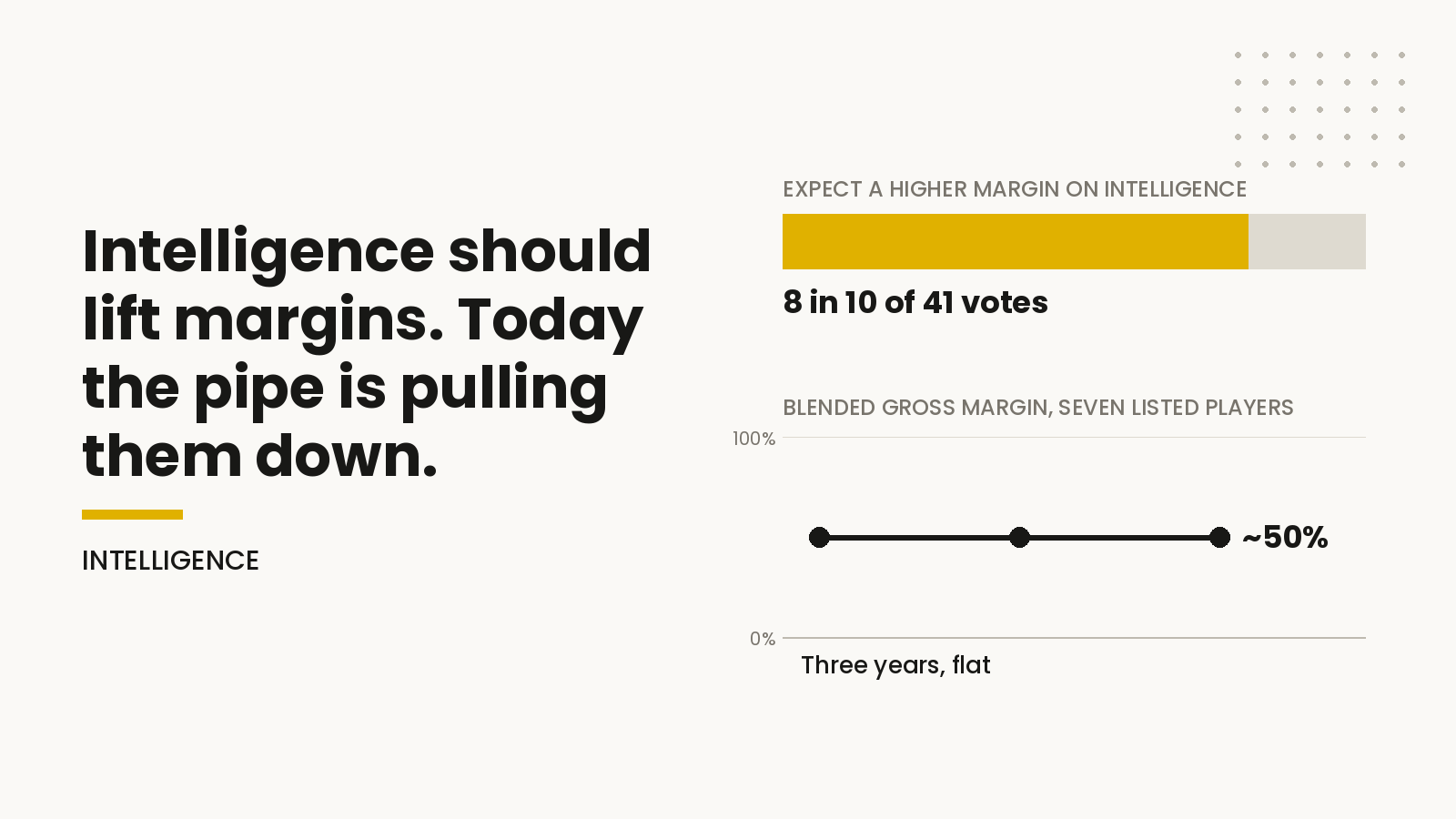
Asked whether the intelligence revenue they win in the next two to three years will earn a higher gross margin than transport revenue today, 29% of 41 participants said much higher and 51% said a little higher. Ten percent expected about the same, and 10% a little lower. Eight in ten expect intelligence to be the better business.
The accounts of seven listed players show a flatter picture. Messaging-led gross margins held at 41 to 42%, voice-led at about 66%, and the blended margin stayed at about 50% for three years. Gross profit grew with volume. No uplift is visible in the reported blend.
The pressure is on the pipe, not on the AI
The report looks at why. In the first two cases it cites, the cause is the cost of the transport, not the cost of intelligence. Twilio’s CFO said its gross margin would have risen rather than fallen in the second quarter of 2026 but for US carrier pass-through fees. CM.com carried 30% more messages for 3% more gross profit.
The third case is less comfortable. Sinch’s gross margin fell from 35.2% to 33.5% between the fourth quarter of 2025 and the second quarter of 2026. Five9’s fell from 63% to 61% in the very quarter it reported 78% growth in AI revenue. So even where intelligence revenue is growing fast, it is not yet big enough to move the blend.
A race between two curves
This is where the margin question becomes a pace question. Analysts such as IDC forecast conversational AI software services growing more than four times as fast as CPaaS, so the direction is not in doubt. What is in doubt is whether intelligence arrives quickly enough, and at a high enough margin, to outrun the compression underneath it.
There is a useful way to keep score. One of the four scenarios for 2030, Wholesale Signals, has a specific warning sign: volume grows faster than revenue, and revenue grows faster than margin. CM.com’s 30% more messages for 3% more gross profit is that pattern at one player. Whether it shows up across the industry is what the next few years of results will tell us.
For the eight in ten who expect a better margin, that is the test to pass. The margin is a promise. The accounts are where it will be kept or not.
The margin evidence and the four scenarios for 2030 are set out in full in The State of Intelligent Engagement 2026.
Researched and written by Andrew Collinson of Connective Insight, commissioned by CPaaSAA.

I've spent my career in IT and telecoms building bridges, from the early days of cloud communications to today's reset around APIs, CPaaS and AI.
As Founding Partner of The Next Cloud and CPaaSAA, I help telcos, CPaaS players and AI-native scaleups work out where they fit in the AI era, through strategy, ecosystem building and events.
My view: the value is moving from platforms to outcomes, and real innovation comes from ecosystems, not incumbents acting alone.
Based in Amsterdam, usually somewhere else.
Comments are closed