

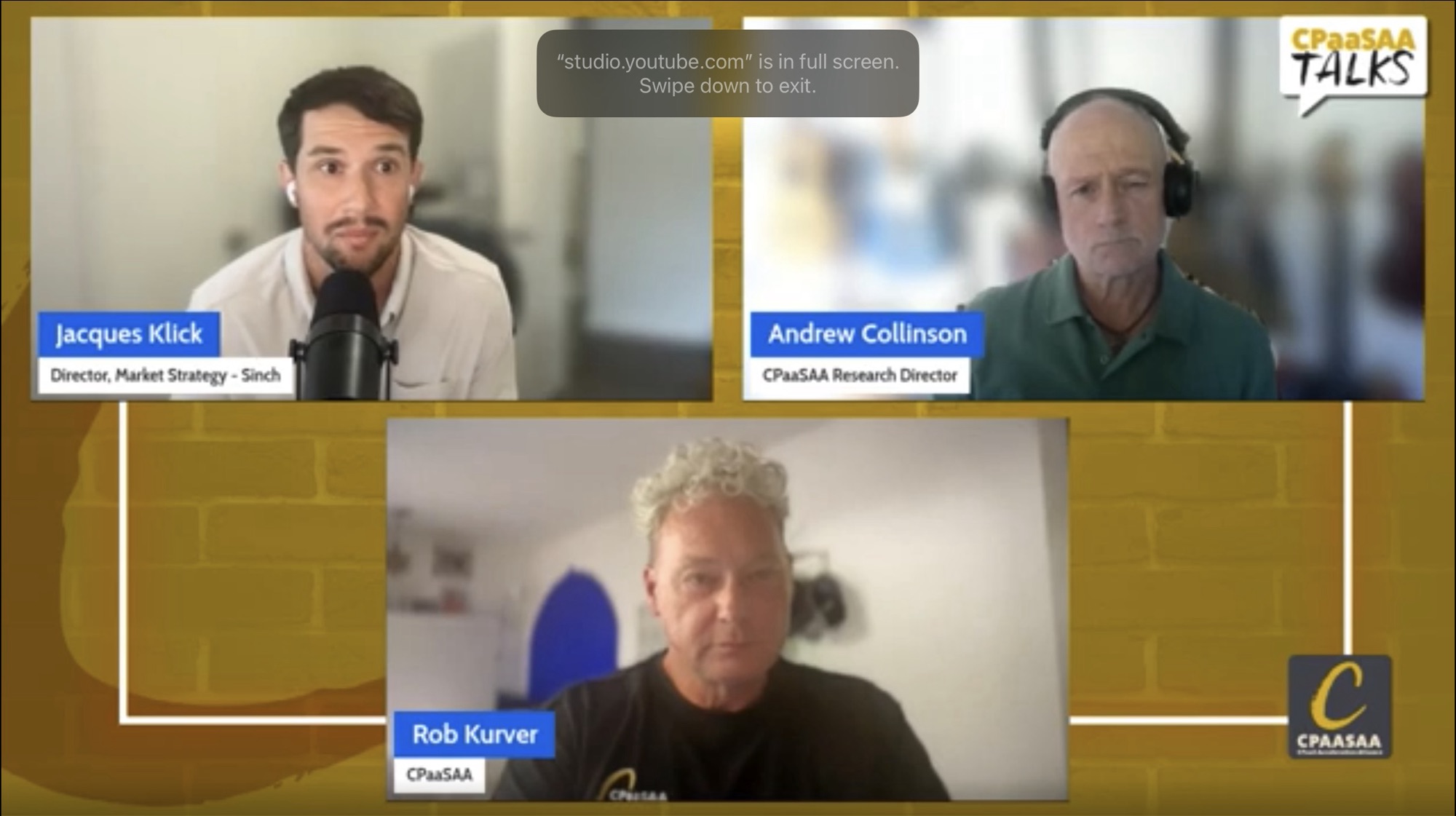
A CPaaSAA Talk with Jacques Klick, Director of Market Strategy at Sinch, joined by Andrew Collinson and Rob Kurver.
When we published AI Voice: Who Will Run the Conversation? earlier this year, the question in the title was meant as a strategic one – which layer ends up orchestrating the models, enforcing the policy, and holding the context when a conversation crosses channels.
In this CPaaSAA Talk, Jacques Klick of Sinch answered it in the present tense. Today, nobody does. Or, as he put it: whoever drew the short straw on the engineering team.
That is the value of putting Sinch’s enterprise survey – The AI Production Paradox, drawn from more than 2,500 senior decision-makers across ten countries – next to our own industry-side research. We asked who will run the conversation. Their data shows what happens in the meantime, when nobody is.
The rollback rate is a maturity signal, not a failure signal
The headline finding cuts against the story the market has been telling itself for two years. Enterprises were supposed to be stuck in pilot purgatory. In customer communications, they are not: 62% already have agents live, messaging real customers, outside the sandbox.
Then 74% of those companies had to roll something back.
The instinct is to read that as a failure rate. Klick reads it as an observability rate – and this is the sharpest thing said in the hour. A high rollback number means the organisation had the instrumentation to catch an agent leaking personal data or stepping outside its governance envelope, and the operational discipline to pull it. The teams that worry him are the ones reporting no rollbacks at all.
His question for them: if the agent had gone off the rails, how would you know?
That reframing matters for everyone in this ecosystem, because it changes what a reference customer looks like. A partner who can show you what they caught, when they caught it, and what they did next is demonstrating something a clean deployment record cannot.
The runtime everyone is designing already exists – as a ticket backlog
Our AI Voice research described a runtime layer: the thing that holds context, applies policy, routes between models and humans, and produces an audit trail. Klick’s read on it was blunt. That runtime is not missing. It is being hand-built, ticket by ticket, inside enterprises that never intended to be in the communications infrastructure business.
The survey puts the majority of internal engineering time on plumbing – masking customer data, rate limits, retry logic, audit logs – rather than on anything a customer would notice.
The economics of that are the part worth sitting with. Software costs normally fall as you scale. This cost curve goes the other way. Every additional channel, every additional agent, every additional market adds another layer that somebody has to maintain permanently, and the build is the cheap part. The maintenance, the monitoring, the analytics on every interaction – that is the recurring bill.
Andrew Collinson put the strategic question to Klick directly: is governance something enterprises will treat as their own competitive IP, or will they buy it? Nobody stops the do-it-yourself route, and nobody should try. But the case has to be made on evidence rather than assertion – a partner who has done this across hundreds of deployments knows more about the failure modes than a customer who has done it once, and knows less about that customer’s specific instance. Proving the first outweighs the second is the commercial argument of the next two years.
Voice moved to the front – including in the industries where it shouldn’t have
Two-thirds of the enterprises surveyed now rate voice equal to or above messaging in importance. More than 40% point to fully autonomous call handling as the single biggest opportunity in front of them. Three years ago that would have been an outlier position.
What is more striking is where it holds. The survey was concentrated in financial services, healthcare, telecoms, technology and retail – and the appetite for autonomous voice did not thin out in the regulated verticals. The assumption that HIPAA or financial conduct rules would keep voice at arm’s length has not survived contact with the data.
Klick’s read: enterprises expect their communications partners to solve that problem for them. Andrew’s caution is the right one to hold alongside it – the question of when a human comes back into the chain is unresolved, and the anecdotal evidence is contradictory across jurisdictions. Recorded calls read as protective compliance evidence in one market and as litigation exposure in another. Nobody has clean data on that yet. It is a live gap, and one worth putting to the room in Amsterdam.
The strongest predictor of AI success was not AI
The finding that should reset a few 2027 roadmaps came at the end.
Sinch tested some 4,000 variable pairs to find what most determined enterprise confidence in AI agents working across communications. The winner was not model choice, not feature depth, not price. It was how the enterprise felt about its underlying communications infrastructure.
Reliability outranked intelligence.
That lands awkwardly in an industry currently competing on how fast it can move up the stack – and it is why we keep saying that Trust and Intelligence are two pillars rather than one. The intelligence layer is where the new value is created. The transport layer is what determines whether anybody trusts the intelligence enough to let it talk to their customers unsupervised. A voice agent with a beautiful reasoning trace and 400ms of added latency is not a product. An email agent that composes perfectly into a spam folder is not a product either.
Moving up the stack does not mean leaving the bottom of it unattended. It means the bottom becomes the permission to sell the top.
What gets productised next
The most concrete part of the conversation was about what happens to twenty years of accumulated regulatory and deliverability expertise now that developers are working inside AI coding tools.
Sinch’s answer is to package it – turning campaign setup, channel registration and regulatory sequencing into downloadable skills a developer invokes in natural language from the IDE, and turning vertical use cases into pre-built conversational packages. Loan recovery for banks was the example: a difficult, high-revenue, tightly regulated conversation, shipped as a configurable package rather than a professional services engagement.
That is the shape of the next act. Expertise that used to travel as consultants starts travelling as templates. Which raises the question we will put on stage at CASA26 in September: when the expertise is packaged, what is left that is genuinely defensible – and who in this ecosystem is building it?
We are grateful to Jacques for an unusually candid hour. The full Talk is available now, and this conversation continues in Amsterdam, 21-23 September.
Watch the full video here: https://youtu.be/ZOnS7DsbHJA

I've spent my career in IT and telecoms building bridges, from the early days of cloud communications to today's reset around APIs, CPaaS and AI.
As Founding Partner of The Next Cloud and CPaaSAA, I help telcos, CPaaS players and AI-native scaleups work out where they fit in the AI era, through strategy, ecosystem building and events.
My view: the value is moving from platforms to outcomes, and real innovation comes from ecosystems, not incumbents acting alone.
Based in Amsterdam, usually somewhere else.
Comments are closed