

The headline number looks healthy. Across 82 countries, Number Verification can be bought in some form for 63% of mobile connections. Look underneath it and the picture changes.
China and India hold about two-fifths of those connections, and buyers there can get Number Verification for 96% of theirs. Take those two countries out and the figure for the other 80 drops to 43%. In 48 countries, Mobile Network APIs: Signals of Value could not trace a single buyable route.
Sixteen countries out of 82 clear the bar
Based on what buyers told the research team, the report uses 75% buyable coverage as an analytical benchmark for broad reach. The exact level a buyer needs depends on the use case and on whether there is a fallback, but below that line most large businesses will hesitate to rebuild a core process around the service.
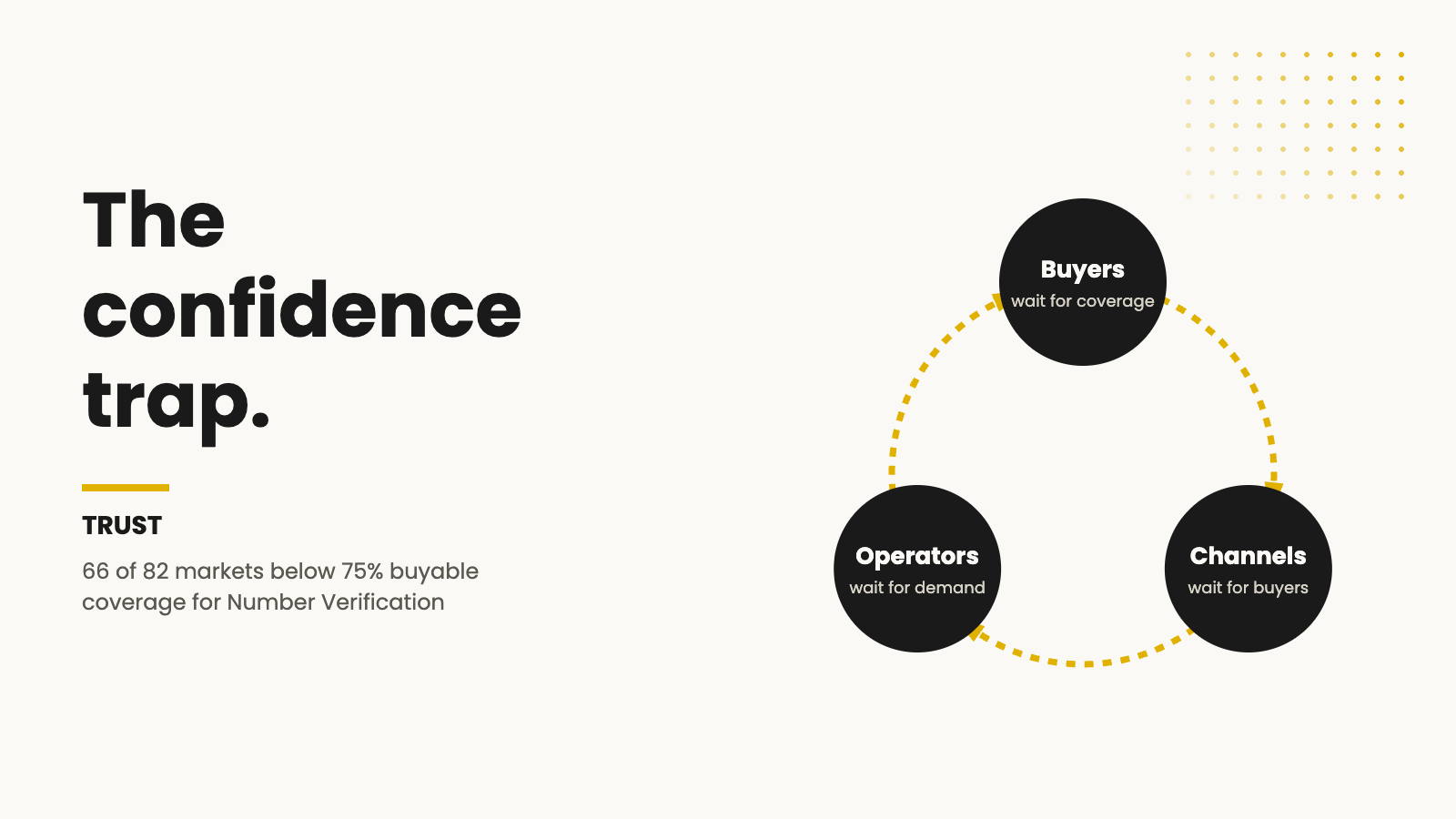
Sixteen countries reach it for Number Verification in some form, and 16 for SIM Swap. Twelve reach it for both. On a stable CAMARA version, two countries reach it for Number Verification and one for SIM Swap. In the other 66 countries, a buyer that wants broad reach cannot get it today.
Three groups, each waiting for the other two
This is where the market gets stuck. Buyers wait for coverage and evidence before they commit. Channel partners need both ready buyers and broader supply before they invest in selling. And many operators wait for proven demand before they push the product hard.
Each position is rational on its own. Together they form a confidence trap: a loop in which everyone behaves sensibly and nothing moves as fast as it could. No single company caused it, and no single company can break it.
The way out is coverage you can check and results you can see
The report is clear about what breaks the loop: wider, checkable coverage and published evidence. Operators who make their offers easy to find and buy through channels move a country closer to the benchmark. Channels and buyers who publish what the signals did for them give operators the demand signal they are waiting for.
The encouraging part is that both are within the industry’s own control. Nobody needs a regulator, a new standard or a technology breakthrough to publish an offer or a result. Someone just has to go first, and it is much easier when several go together.
Traps like this do not open on their own. Which country will be the 17th to clear the bar?
The public edition of Mobile Network APIs: Signals of Value is free to download. The Detailed report, with buyable coverage country by country, is included in CPaaSAA membership. Non-members can buy it from the same page.
From Mobile Network APIs: Signals of Value, researched and written by Andrew Collinson of Connective Insight, commissioned by CPaaSAA.

I've spent my career in IT and telecoms building bridges, from the early days of cloud communications to today's reset around APIs, CPaaS and AI.
As Founding Partner of The Next Cloud and CPaaSAA, I help telcos, CPaaS players and AI-native scaleups work out where they fit in the AI era, through strategy, ecosystem building and events.
My view: the value is moving from platforms to outcomes, and real innovation comes from ecosystems, not incumbents acting alone.
Based in Amsterdam, usually somewhere else.
Comments are closed